
Navigating Invoicing Challenges as a Freelance Web Developer in Canada
Freelance web developers face a unique set of billing challenges that most other professions never encounter. A single project can span months, involve multiple billing models simultaneously, and require you to pass through third-party costs alongside your own labour charges. Whether you are building a custom React application, deploying a headless CMS, or maintaining a fleet of client WordPress sites, your invoices need to clearly communicate the value you delivered. Developers who also handle the visual side of projects will find overlap with how graphic designers structure their billing, especially when design and development milestones are interleaved.
Project Milestone Billing and Scope Creep Protection
The most effective way to protect yourself from scope creep is to tie your invoicing to clearly defined milestones. A typical web development project might be split into four phases: discovery and wireframing (20%), design and prototyping (25%), development and integration (40%), and testing, launch, and handoff (15%). Each milestone triggers an invoice, and no new phase begins until the previous invoice is paid. This structure protects both you and your client. When clients request features outside the original scope, you can issue a separate change-order invoice with its own line items, keeping the original project budget intact.
Hourly vs. Fixed-Price and Retainer Agreements
Choosing between hourly and fixed-price billing depends on project clarity. For well-defined builds with clear specifications, fixed-price invoicing gives clients budget certainty and rewards your efficiency. For ongoing maintenance, bug fixes, and ad-hoc requests, hourly billing tracked through a time tracking tool ensures you are compensated for every minute of work. Many developers use a hybrid model: fixed price for the initial build, then a monthly retainer for ongoing support. Your invoices should clearly distinguish between these billing models so clients understand what they are paying for.
Hosting, Domains, and Pass-Through Costs
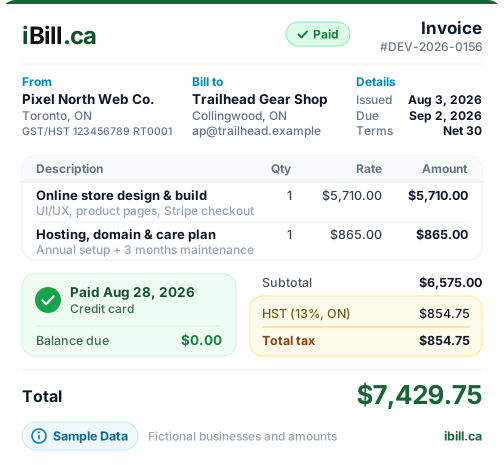
Web developers commonly procure hosting, domain names, SSL certificates, CDN services, and third-party API subscriptions on behalf of their clients. These pass-through costs should appear as separate line items on your invoice, either at cost or with a management markup. Be transparent about which costs are yours and which are third-party, as this builds trust and makes it easier for clients to take over these services if they choose to. IT consultants face similar challenges when procuring hardware or software licenses for their clients. When it comes time to convert your tracked hours into a final bill, having a streamlined workflow to convert billable hours to invoices will save you hours of administrative work each month.