
Accounting Software for Canadian Businesses
Double-entry bookkeeping with province-specific tax handling. Balance sheets, income statements, CCA depreciation, bank reconciliation, and CRA-ready tax reports.
Accounting Features
Every accounting tool a Canadian small business needs, from basic bookkeeping to CRA tax reports. All all built for Canadian tax law.
Balance Sheet
Real-time balance sheets showing assets, liabilities, and equity. ASPE-ready format for Canadian businesses.
Learn moreIncome Statement
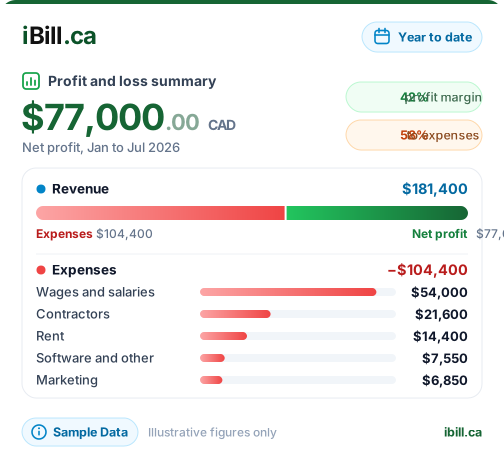
Profit and loss reports with revenue, expenses, and net income. Revenue shown when paid (cash basis).
Learn moreChart of Accounts
Pre-configured Canadian chart of accounts with tax liability accounts for GST/HST, PST, and QST.
Learn moreDouble-Entry Accounting
Full double-entry bookkeeping with automatic journal entries for every financial transaction.
Learn moreGeneral Ledger
Complete general ledger with drill-down into individual journal entries and transaction details.
Learn moreBank Reconciliation
Import bank statements and reconcile transactions against your books with matching rules.
Learn moreBank Statement Import
Import CSV and OFX bank statements. Auto-categorize transactions with custom rules.
Learn moreRevenue Basis + s.168 Sales Tax
Dashboard revenue counts invoices when issued; the Profit and Loss report shows revenue when paid. Sales-tax reports follow Excise Tax Act s.168 timing.
Learn moreCCA Depreciation
Capital Cost Allowance tracking with the common CRA asset classes, half-year rule, and AIIP.
Learn moreFinancial Statements
Complete financial statement suite: balance sheet, income statement, and trial balance.
Learn moreAccounts Payable
Track vendor bills, manage payments, and monitor AP aging. Full accrual-basis AP tracking.
Learn moreCRA Tax Reports
Generate GST/HST return data, tax summaries by period, and CRA-ready filing reports.
Learn moreComplete Accounting. Zero Cost.
Double-entry bookkeeping, financial statements, and CRA tax reports. All included for Canadian businesses.
Create AccountAccounting Software by Province
Province-specific accounting guides covering local tax handling, GL account setup, and CRA reporting requirements for each region.
Ontario
HST accounting with single tax liability account. Ontario's largest small business market.
13% HSTLearn more
British Columbia
Dual GST/PST accounting with separate liability accounts. PST is non-recoverable.
5% GST + 7% PSTLearn more
Alberta
GST-only accounting. Simplest provincial setup with single tax liability.
5% GST OnlyLearn more
Saskatchewan
Dual GST/PST accounting. Saskatchewan PST has unique exemption rules.
5% GST + 6% PSTLearn more
Manitoba
GST/RST accounting. Manitoba's Retail Sales Tax has different rules than PST.
5% GST + 7% RSTLearn more
Atlantic Canada
HST accounting for NB, NS, NL, and PEI. Single tax liability account, varying rates.
14-15% HSTLearn more
Accounting Software by City
City-specific accounting resources covering local business requirements, industry trends, and professional services available in your metro area.
Toronto & Ontario
Accounting for Ontario businesses. Canada's financial capital with diverse industries across the GTA and beyond.
13% HSTLearn more
Vancouver & BC
Accounting for Vancouver and BC businesses. Tech, film, real estate, and professional services.
5% GST + 7% PSTLearn more
Calgary & Alberta
Accounting for Alberta businesses. Energy sector, agriculture, and tech startups in Calgary and Edmonton.
5% GST OnlyLearn more
How Provincial Taxes Affect Your Bookkeeping
Canadian accounting is more complex than it looks. Here's what your province means for your books.
Different provinces require different GL account structures. In HST provinces like Ontario, you track a single combined tax liability. In GST+PST provinces like BC, you need separate accounts for GST (recoverable as an Input Tax Credit) and PST (non-recoverable, treated as a business expense). In Quebec, the QST calculation differs from all other provinces because it's applied to the subtotal only, not compounded on GST.
Tax reporting varies by province. GST/HST is reported to the CRA on your GST/HST return. But PST is reported separately to each provincial authority (BC Ministry of Finance, Saskatchewan Ministry of Finance, Manitoba Finance). Quebec businesses report QST to Revenu Quebec, not the CRA. Your accounting software needs to track these separately so you can file the correct returns with the correct agencies.
ITC eligibility depends on tax type. GST and HST paid on business purchases can be claimed as Input Tax Credits on your CRA return, reducing the amount you owe. PST paid in BC, Saskatchewan, and Manitoba is generally not recoverable and must be expensed. QST in Quebec is recoverable through Input Tax Refunds (ITRs) filed with Revenu Quebec. iBill.ca tracks ITC eligibility automatically, posting GST/HST to a recoverable account and PST to an expense account.
Whether you're generating a balance sheet, reviewing your income statement, reconciling bank transactions, or calculating CCA depreciation, iBill.ca handles the provincial complexity so you can focus on running your business.
Frequently Asked Questions
Common questions about Canadian accounting software
Ready to start with Canadian accounting software?
Get Started TodayAccounting Software for All of Canada
Every province. Every tax system. Full double-entry bookkeeping. One platform.
Create Account