iBill.ca
Get Started
Built for Cleaning Businesses

Cleaning Service Invoice Software with Recurring Billing

Professional invoicing for Canadian cleaning services. Track hourly rates, flat fees, and supplies. Manage recurring clients easily. Automatic GST/HST calculation for every province. CRA-ready invoices.

All-in-One
Platform
Unlimited Invoices
13
Provinces Supported

Features Cleaning Services Actually Need

Invoice software designed for how house cleaners and janitorial services really work

🔄

Recurring Service Schedules

Set up weekly or bi-weekly cleaning clients and duplicate their invoice with one click each billing cycle. The base service, add-ons, and client preferences carry forward. When 80 percent of your revenue is recurring, fast repeat invoicing saves hours every month.

📏

Square Footage Pricing Support

Bill by square footage for commercial contracts or by room count for residential clients. Show the rate per square foot and total area on the invoice so clients can verify the math. This makes annual rate adjustments transparent and easy to justify.

🧹

Supply Cost Tracking

Add cleaning supplies as separate line items or build them into your flat rate. Track eco-friendly product premiums, commercial-grade disinfectants, and specialty floor cleaners. Knowing your true supply costs per job prevents underpricing your services.

🏠

Deep Clean & Move-Out Premiums

Invoice deep cleans, move-in/move-out services, and post-renovation cleanups at premium rates. Itemize each task (oven degreasing, cabinet interiors, window tracks) so property managers see exactly what was done and why the price is higher.

🏢

Commercial Contract Billing

Bill office buildings, retail spaces, and medical clinics with monthly recurring invoices. Separate "Contract Services" from "Additional Services Requested" to prevent unpaid scope creep on long-term janitorial agreements.

📈

Job Costing Per Client

See your invoice history per client to evaluate profitability. If a recurring job consistently runs over the quoted time or requires extra supplies, your invoice records help you make the case for a rate adjustment at the next annual review.

Cleaning Services: Create Professional Invoices in 60 Seconds

iBill creates CRA-ready invoices for cleaning services with automatic tax calculations and professional PDF export.

Create Invoice
Trusted by Canadian Businesses — 1,200+ signups

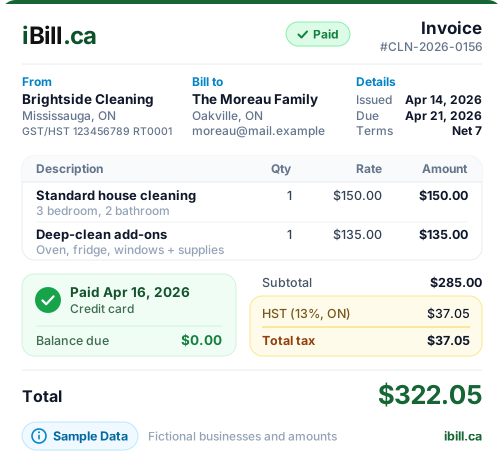
Sample Cleaning Service Invoice

Here's what your professional cleaning invoice will look like

Invoice #CLN-2024-0156 - Residential Cleaning Service

Description Qty Rate Amount
Regular Cleaning
Standard House Cleaning (3BR, 2BA) 1 $150.00 $150.00
Deep Clean Add-Ons
Oven Deep Clean (interior & exterior) 1 $45.00 $45.00
Refrigerator Deep Clean 1 $35.00 $35.00
Inside Window Cleaning (all rooms) 1 $40.00 $40.00
Supplies
Eco-Friendly Cleaning Products 1 $15.00 $15.00
Subtotal: $285.00
HST (13%): $37.05
Total: $322.05

Notes: Bi-weekly cleaning service. Next scheduled visit: January 15, 2026. Client provides vacuum and mop.

Why Cleaning Services Choose iBill.ca

🔄

Built for Repeat Billing

Most cleaning revenue is recurring. Duplicate last week's invoice in seconds, adjust any add-ons, and send. No re-entering client details every visit.

📱

Invoice on the Drive Home

Finish a job, open your phone, duplicate, send. Your invoice reaches the client's inbox before you reach your next appointment. No end-of-day admin pile-up.

💰

No Overhead on Thin Margins

Cleaning margins are tight. iBill adds zero cost to your business, no subscriptions, no per-invoice fees, no percentage of revenue. Every dollar earned stays earned.

🧾

Province Tax Auto-Applied

Service clients in Ontario (13% HST), Alberta (5% GST), or BC (5% GST + 7% PST). The correct tax appears automatically based on the client's location.

📊

End-of-Year Tax Reports

Pull GST/HST collected across all clients in one report. Hand it to your accountant at tax time instead of sorting through bank deposits and receipts.

🏠

Scope Documentation

Your invoice is proof of what was agreed. When a client disputes whether window washing was included, the line item record settles it immediately.

Invoice Any Type of Cleaning Work

From residential to commercial cleaning services

🏠

Residential Cleaning

Houses, condos, apartments

🏢

Commercial Cleaning

Offices, retail, warehouses

📦

Move-In/Out

Deep cleans for moves

Deep Cleaning

Spring cleaning, one-time

💻

Office Cleaning

Daily or weekly service

🧻

Carpet Cleaning

Steam cleaning, spot removal

🪟

Window Cleaning

Interior and exterior

🚧

Post-Construction

New build clean-up

Cleaning Service Invoice FAQs

How do I price a move-out cleaning versus a regular cleaning on my invoice?
Move-out cleanings typically cost 2 to 3 times more than a standard recurring visit because of the intensity of work involved, including cleaning inside empty cabinets, degreasing range hoods, scrubbing tile grout, and cleaning behind appliances. With iBill.ca, itemize each task separately on the invoice rather than showing a single "move-out clean" line. Property managers compare cleaning invoices across vendors, and detailed line items demonstrate the full scope of work performed.
Should I include cleaning supplies in my flat rate or bill them separately?
For residential clients, building a $5 to $15 supply premium into your flat rate is simpler and avoids invoice clutter. For commercial accounts that require specialized products like hospital-grade disinfectants, anti-static cleaners, or marble-safe solutions, billing supplies as a separate line item makes more sense since these can add $50 to $200 per month. iBill.ca supports either approach and lets you track the actual supply cost difference for your own records.
How do I handle a commercial client who keeps adding tasks beyond our contract?
Scope creep is one of the biggest profit killers for cleaning businesses. Structure your iBill.can invoices with two clear sections: "Contract Services" for the agreed-upon base scope, and "Additional Services Requested" for anything extra like carpet spot cleaning, kitchen deep cleans, or boardroom resets. This documents every add-on and gives you leverage to renegotiate the base contract at renewal time.
How often should I invoice residential cleaning clients?
Most residential cleaning businesses in Canadan invoice after each visit or monthly for recurring clients. Per-visit invoicing with iBill.ca is fast since you can duplicate the previous invoice and adjust add-ons. Monthly invoicing works well for clients on a weekly schedule because it reduces the number of e-Transfer transactions. Whichever frequency you choose, consistent invoicing prevents the awkward "how much do I owe you?" conversation.
What should I put on my invoice if the property was dirtier than expected?
Many cleaning companies bill a "condition surcharge" of $50 to $150 if a property is significantly worse than described during booking. Add this as a separate line item on your invoice with a brief note explaining the additional work required. If you took before-and-after photos, reference them in the invoice notes. iBill.ca's description fields give you space to document the reason, which protects you from disputes with property managers or landlords.

Ready to streamline your cleaning business invoicing?

Create Invoice

Why Cleaning Service Professionals in Canada Need Dedicated Invoice Software

Running a cleaning business in Canada means managing a high volume of relatively small invoices across dozens of clients each week. A residential cleaning company might service 15 to 25 homes per week at $120 to $300 per visit, while a commercial cleaning operation could invoice 5 to 10 office buildings monthly at $800 to $3,000 each. The sheer repetition of these invoices -- same client, same service, same amount, different date -- makes manual invoicing painfully inefficient. What changes between visits are the extras: deep cleaning the oven, shampooing carpets, washing interior windows, or post-renovation dust cleanup. Your invoicing system needs to handle a recurring base amount with easy-to-add one-time line items.

Pricing models in the cleaning industry vary significantly, and your invoices need to reflect whichever approach you use. Some operators charge by the hour ($35 to $55 per cleaner per hour is typical in major Canadian cities), others price by square footage ($0.08 to $0.15 per square foot for commercial), and many residential cleaners use flat rates based on home size and number of bathrooms. Move-in and move-out deep cleans are a separate category entirely, often priced 2x to 3x a regular cleaning because of the intensity of work involved -- scrubbing inside empty cabinets, degreasing range hoods, and cleaning behind appliances. This pricing diversity is something cleaning businesses share with landscaping companies and painting contractors, where job scope varies dramatically from one booking to the next.

Recurring Contracts and Supply Cost Management

The most successful cleaning businesses build their revenue on recurring contracts -- weekly residential cleanings and monthly or bi-weekly commercial janitorial agreements. Managing these with recurring invoices eliminates hours of administrative work each month and ensures you never forget to bill a client. But recurring billing introduces its own challenge: how do you handle price increases? Most cleaning contracts in Canada include an annual rate review, and your invoicing system should let you adjust the recurring amount without losing the history of what the client previously paid. Clear communication of rate changes on the invoice itself reduces pushback and sets professional expectations.

Supply costs are often underestimated by new cleaning business owners. Commercial-grade disinfectants, microfiber cloths, vacuum filters, and specialized products for stone or hardwood surfaces add up to $200 to $500 per month for a solo operator and significantly more for a team. Whether you include supplies in your flat rate or bill them separately as a line item depends on your business model, but either way you need to track these costs accurately for CRA deduction purposes. Understanding proper payment terms is also critical in this industry, because residential clients typically pay on completion while commercial contracts often operate on net-30 terms, creating cash flow gaps that catch many cleaning business owners off guard during their first year of operation.

Square Footage Models, Deep Clean Premiums, and Scaling a Cleaning Business in Canada

Square footage-based pricing is the most scalable invoicing model for cleaning businesses that want to move beyond guessing at flat rates. The formula is straightforward: measure the total cleanable square footage, apply your per-square-foot rate, and adjust for the service level. For residential clients in major Canadian cities, standard recurring cleaning runs $0.08 to $0.12 per square foot, meaning a 2,000-square-foot home invoices at $160 to $240 per visit. Commercial office cleaning typically ranges from $0.05 to $0.10 per square foot for basic janitorial (vacuuming, trash, washroom restocking, surface wiping) and $0.12 to $0.20 for detailed cleaning that includes baseboard wiping, blind dusting, and glass partition cleaning. Your invoice should show the square footage, the applied rate, and any add-on charges so clients can verify the math. This transparency also makes rate adjustments easier to justify -- when you raise your per-square-foot rate by $0.01, the client sees it adds only $20 to their 2,000-square-foot visit rather than perceiving an arbitrary price increase. This measured approach to pricing is conceptually similar to how painting contractors use per-square-foot rates to standardize their quoting across different-sized spaces.

Move-In/Move-Out and Post-Construction Cleaning Premiums

Move-in and move-out cleanings are among the most profitable services a cleaning business can offer, and your invoicing must reflect the premium nature of this work. A move-out clean for a 1,200-square-foot apartment in Vancouver or Toronto typically ranges from $350 to $600 -- two to three times the cost of a standard recurring visit. The premium is justified by the intensity of the work: cleaning inside every cabinet and drawer, degreasing the oven and range hood, scrubbing tile grout, cleaning window tracks, and removing years of accumulated grime from behind appliances. Your invoice should itemize these tasks individually rather than showing a single "move-out clean" line, because property managers and landlords often compare cleaning invoices across vendors and detailed line items demonstrate the scope of work performed. Many cleaning companies also bill a separate "condition surcharge" of $50 to $150 if the unit is in significantly worse condition than described during the booking -- documenting this with before photos referenced on the invoice protects you from disputes.

Post-construction cleaning is another premium tier that demands its own pricing structure. Rough cleans (removing debris, dusting framing, sweeping) run $0.15 to $0.25 per square foot. Final detail cleans (removing tape residue, cleaning fixtures, polishing surfaces, removing paint overspray from windows) command $0.25 to $0.50 per square foot. Your invoice for construction cleaning should reference the general contractor's project number or the builder's name, because these expenses are typically claimed by the builder as a project cost. Understanding CRA invoice requirements ensures your documentation meets the builder's needs for their own tax filings.

Commercial Contracts: Scope Creep and Supply Billing

Commercial cleaning contracts are lucrative but prone to scope creep -- the gradual expansion of expected services beyond the original agreement. A contract that started as "nightly vacuuming, trash, and washroom restocking for $1,800/month" slowly absorbs kitchen cleaning, fridge cleanouts, boardroom resets, and window washing without any corresponding invoice adjustment. Your invoicing strategy should include a detailed scope document referenced on every recurring invoice, with a clear line separating "Contract Services" from "Additional Services Requested." When the office manager asks you to add carpet spot cleaning or deep-clean the staff kitchen, that request should generate a supplemental line item on the next invoice rather than being absorbed into the base rate. Over 12 months, unreimbursed scope creep on a single commercial account can cost $2,000 to $5,000 in uncompensated labour.

Whether to include cleaning supplies in your rate or bill them separately is a strategic decision that affects your invoicing. The "supplies included" model ($5 to $15 per visit premium built into the rate) is simpler to invoice and preferred by most residential clients who do not want a separate line item for $3.50 worth of glass cleaner. The "supplies extra" model works better for commercial accounts where specialized products (hospital-grade disinfectants, anti-static cleaners for server rooms, marble-safe products for lobbies) can add $50 to $200 per month to the cost. When billing supplies separately, your invoice should show the product category and total rather than itemizing every bottle -- "Cleaning Supplies (commercial disinfectant, glass, floor): $85" is professional, while a 15-line supply receipt is excessive. Track your actual supply costs through expense tracking to ensure your "supplies included" premium actually covers your real costs, which many cleaning businesses discover it does not after their first full year of operation.

Ready to Invoice Like a Pro?

Canadian cleaning services use iBill.ca to create professional invoices. Easy to use, CRA-ready.

Create Account

Unlimited Invoices | CRA-Ready