
Understanding which business expenses you can deduct is crucial for minimizing your tax burden and staying ready with the Canada Revenue Agency (CRA). This comprehensive guide covers all major expense categories, deduction rules, and record-keeping requirements for Canadian businesses.
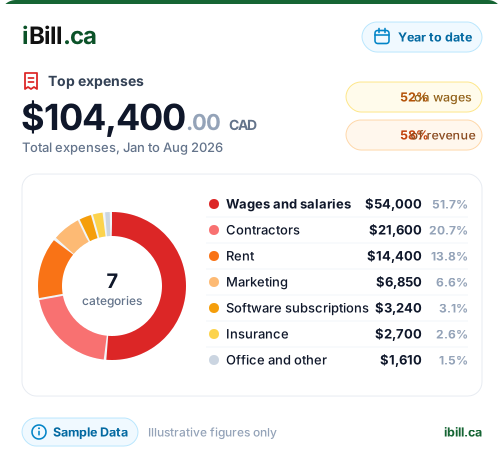
Common Deductible Business Expenses
The CRA allows you to deduct reasonable expenses incurred to earn business income. Here are the main categories of deductible expenses:
Major Expense Categories
- Advertising and Marketing: Website, business cards, online ads, signage
- Office Expenses: Supplies, postage, software subscriptions
- Professional Fees: Accounting, legal, consulting services
- Business Use of Home: Portion of rent, utilities, insurance
- Vehicle Expenses: Gas, maintenance, insurance (business portion)
- Meals and Entertainment: Client meals, business lunches (50%)
- Travel Expenses: Business trips, conferences, hotels
- Insurance: Business liability, professional liability
- Interest and Bank Charges: Business loans, credit card fees
- Telephone and Utilities: Business portion of phone, internet
Home Office Deductions
If you work from home, you can claim a portion of your home expenses. The CRA offers two methods for calculating home office expenses:
Method 1: Simplified Flat Rate
Claim $2 per day worked from home, up to a maximum of $500 per year. No receipts required, but you must track the days worked from home.
Method 2: Detailed Calculation
Calculate the percentage of your home used exclusively for business, then apply that percentage to eligible expenses:
Eligible Home Office Expenses
- Rent: Your monthly rent multiplied by business-use percentage
- Utilities: Electricity, heat, water (business portion)
- Property Taxes: If you own your home
- Home Insurance: Business portion of premiums
- Mortgage Interest: Not the principal, only interest (homeowners)
- Maintenance: General repairs and upkeep (prorated)
- Internet: Business usage portion
How to Calculate Your Home Office Percentage
Measure your dedicated workspace and divide by your total home square footage. For example: 150 sq ft office / 1,500 sq ft home = 10% business use. Apply this percentage to all eligible expenses.
Track Expenses and Deductions with iBill
Categorize business expenses, track GST/HST paid, and generate CRA-ready reports automatically.
Create InvoiceVehicle Expenses
If you use your personal vehicle for business, you can deduct the business-use portion of vehicle expenses. Keep a detailed mileage log to support your claims.
Deductible Vehicle Expenses
- Fuel and oil
- Maintenance and repairs
- Insurance premiums
- License and registration fees
- Lease payments (limits apply)
- Interest on car loans (limits apply)
- Parking fees for business purposes
- Capital Cost Allowance (CCA) for owned vehicles
Vehicle Log Requirement
The CRA expects you to maintain a vehicle logbook recording all business trips, including date, destination, purpose, and kilometres driven. Without a logbook, your vehicle expense claims may be denied during an audit.
Meals and Entertainment (50% Rule)
Meals and entertainment expenses are only 50% deductible, even if they are 100% business-related. This applies to:
- Client lunches and dinners
- Business meeting meals
- Entertainment of clients (concerts, sporting events)
- Staff parties and celebrations (with some exceptions)
| Expense Type | Deductible % | Notes |
|---|---|---|
| Client meals | 50% | Must have business purpose |
| Business lunches | 50% | Document attendees and purpose |
| Entertainment events | 50% | Tickets, venues, activities |
| Long-haul truck drivers | 80% | Special exception for meals |
| Company-wide events | 100% | Up to 6 events per year |
What to Document for Meals
For each meal or entertainment expense, record: date, location, amount, names of attendees, and the specific business purpose discussed. Keep all receipts showing itemized charges.
Professional Fees
Fees paid to professionals for business services are fully deductible:
- Accounting and bookkeeping: Tax preparation, financial statements, CRA representation
- Legal fees: Contracts, business formation, collections
- Consulting fees: Business advisors, IT consultants, marketing experts
- Professional memberships: Industry associations, licensing bodies
- Continuing education: Courses and certifications related to your business
Marketing and Advertising Costs
All reasonable marketing expenses to promote your business are deductible:
Deductible Marketing Expenses
- Website design and hosting
- Business cards and printed materials
- Online advertising (Google Ads, social media)
- Signage and vehicle wraps
- Trade show participation
- Promotional products and giveaways
- Photography and videography
- Email marketing software
Record-Keeping Requirements
Proper documentation is essential for claiming business expenses and surviving a CRA audit. Here are the requirements:
What Records to Keep
- All receipts and invoices for expenses claimed
- Bank and credit card statements
- Vehicle mileage logbook
- Contracts and agreements
- Cancelled cheques
- Home office measurements and calculations
How Long to Keep Records
The CRA requires you to keep business records for at least 6 years from the end of the tax year they relate to. If you file late or are involved in an appeal, you may need to keep records longer.
Digital Records Are Acceptable
You can store receipts digitally using apps or scanning. The CRA accepts digital copies as long as they are complete, legible, and stored securely. Many expense tracking apps can help organize your receipts automatically.
Common CRA Audit Triggers
Avoid these red flags that commonly trigger CRA reviews and audits:
High-Risk Expense Claims
- Claiming 100% vehicle use: Unless you have a dedicated business vehicle, some personal use is expected
- High expense-to-income ratios: Expenses significantly higher than industry norms
- Missing documentation: No receipts or inadequate records
- Mixing personal and business: Claiming personal expenses as business costs
- Inconsistent reporting: Large fluctuations in expense claims year over year
- Cash transactions: Large cash payments without proper documentation
How to Avoid Audit Problems
- Separate business and personal accounts: Use dedicated business banking and credit cards
- Keep detailed records: Document the business purpose for every expense
- Use invoicing software: Track income and expenses systematically
- Be conservative: When in doubt, claim less rather than more
- Consult a professional: Work with an accountant for complex situations
Track Your Business Expenses with iBill
iBill.ca helps Canadian businesses track income, expenses, and GST/HST automatically. Create professional invoices and stay organized for tax time.
Get Started TodayFrequently Asked Questions
What percentage of meals and entertainment can I deduct in Canada?
In Canada, you can generally deduct only 50% of meals and entertainment expenses incurred for business purposes. This applies to client meals, business lunches, and entertainment costs. However, there are exceptions for long-haul truck drivers (80%) and certain special events like company-wide parties (up to 6 per year at 100%).
How do I calculate my home office deduction for CRA?
Calculate the percentage of your home used for business (e.g., office is 150 sq ft of 1,500 sq ft home = 10%). Apply this percentage to eligible expenses like rent/mortgage interest, utilities, property taxes, home insurance, and maintenance. Alternatively, use the simplified flat rate method of $2 per day worked from home, up to $500 annually.
What triggers a CRA audit for business expenses?
Common CRA audit triggers include: claiming 100% of vehicle expenses without a logbook, unusually high expense ratios compared to income, mixing personal and business expenses, claiming home office deductions without a dedicated workspace, and missing or inadequate documentation for claimed expenses.
How long must I keep business expense receipts in Canada?
The CRA requires you to keep all business records, including receipts and invoices, for at least 6 years from the end of the tax year they relate to. If you file late or there is a dispute, you may need to keep records longer. Digital copies are acceptable if they are complete and legible.
Ready to organize your business expenses for tax time?
Create Invoice