
Invoicing
How to Write an Invoice in Canada
Write an invoice in nine steps: your details, your client's, a unique number, the dates, what you did, the amounts, the sales tax, the total, and how and when to pay. Below is each step, a sample, and what changes for hourly, project and international work.
On this page
Key takeaways
- Start with your business name and contact details, your client's name and address, a unique invoice number and the invoice date.
- Describe each item clearly enough to identify it, with quantity or hours, rate and amount.
- If you are registered, show your GST/HST registration number and each tax on its own line.
- Finish with the total, the due date and how to pay.
How to write an invoice, step by step
- Your business details. Your business or trade name, address, email and phone.
- Your client's details. Their name or business name and address, plus a project or purchase-order reference if they use one.
- A unique invoice number. Continue your own series (for example INV-202610-0001, or 1001, 1002); never reuse a number.
- The invoice date and due date. The date you issue it, and when payment is due (for example “Due November 15, 2026” or “Net 30”).
- What you provided. One line per item or service, described clearly enough to identify it: “Logo design, 3 concepts and 2 revisions” rather than “Design work”.
- Quantity, rate and amount. Hours or units, the rate, and the line total.
- Sales tax. If you are registered, your GST/HST registration number, and the tax for your client's province on its own line (GST, HST, PST, RST or QST).
- The total. Subtotal, each tax, and the total due, with the currency.
- How to pay. The methods you accept and the details your client needs, such as your e-Transfer email address.
Then send it as a PDF, keep a copy, and follow up if it isn't paid by the due date.
What the law requires on a Canadian invoice
The legal minimum is about GST/HST. For a business client to claim back the tax you charged, the federal Input Tax Credit Information Regulations require, by invoice total:
| Invoice total | Must show |
|---|---|
| Under $100 | Your business name, the date, and the total. |
| $100 to $499.99 | Also your GST/HST registration number and the tax charged. |
| $500 or more | Also your client's name, the payment terms, and a description of each item. |
The nine steps above cover all three tiers. The full list with examples is in what to include on a Canadian invoice, and the rules by amount are in CRA invoice requirements.
A sample invoice
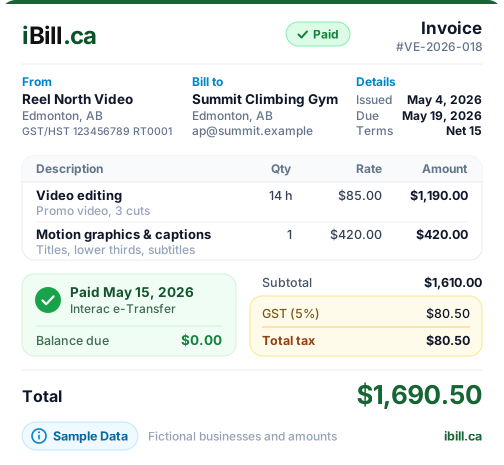
A video editor in Alberta billing an Alberta client: one hourly line, one flat-fee line, GST at 5% on its own line, the total in Canadian dollars, and the payment method.
Hourly, project and retainer invoices
- Hourly: list the hours and the rate on each line, for example “Copy editing, 6 h at $70”. Keep your time records in case the client asks.
- Project (flat fee): one line per deliverable or milestone, matching your quote or contract.
- Retainer: bill the agreed monthly fee at the start of the month, then any hours beyond the retainer separately, so the client sees what was used.
- Deposit: invoice the deposit before you start, then show it as already paid on the final invoice.
To work out what to charge, see how to set freelance rates.
Extra charges and creative work
Charge extras only when your contract or quote set them out in advance, and put each on its own labelled line that refers to the agreement:
- Cancellation (kill) fee: “Cancellation fee per agreement of March 2: 40% of $4,000”.
- Rush fee: “Rush delivery, 48 hours: premium per rate sheet”.
- Extra revisions: “Revisions beyond the 2 included rounds: 3.5 h at $95”.
- Late-payment interest: show the yearly rate as well as any monthly rate (Interest Act, section 4).
For design, writing, photography or code, the creator owns the copyright unless it is assigned, and an assignment is valid only in writing and signed (Copyright Act, section 13). If the client is getting ownership or a licence, say which on the invoice and in the contract.
Invoicing clients outside Canada
You can bill in US dollars or another currency; record the Canadian-dollar amount for your own books and taxes. Services supplied to a non-resident are generally zero-rated (0% GST/HST), subject to conditions: for example, a service performed for someone while they are in Canada, or one relating to real property in Canada, is not. See the GST/HST guide for freelancers.
Do you need to charge GST/HST?
Only once you are registered. You must register when your worldwide taxable sales pass $30,000 in a single calendar quarter or over the last four calendar quarters; below that, registering is optional. Once registered, charge the tax of your client's province for most services. See when to charge GST/HST.
Keep a copy
Keep every invoice you send, with the records behind it, generally for six years from the end of the tax year it relates to.
Questions
How do I write an invoice in Canada?
What does an invoice legally need to include?
Can I invoice in US dollars?
Do freelancers need to charge GST/HST?
How long should I keep my invoices?
Sources
- Input Tax Credit Information (GST/HST) Regulations, section 3 (Justice Laws Website) — checked October 19, 2026
- Excise Tax Act, section 148: small supplier (Justice Laws Website) — checked October 19, 2026
- Excise Tax Act, Schedule VI, Part V: exports (Justice Laws Website) — checked October 19, 2026
- Copyright Act, section 13: ownership (Justice Laws Website) — checked October 19, 2026
- Interest Act, section 4 (Justice Laws Website) — checked October 19, 2026
- Income Tax Act, section 230: records and books (Justice Laws Website) — checked October 19, 2026
This guide is general information, not tax or legal advice. Confirm your situation with an accountant or the CRA.