Late payments are one of the biggest challenges facing Canadian small businesses and freelancers.
According to industry data, nearly 60% of invoices in Canada are paid late, affecting cash flow
and business operations. This comprehensive guide will help you prevent late payments, handle
them professionally when they occur, and know when to escalate.
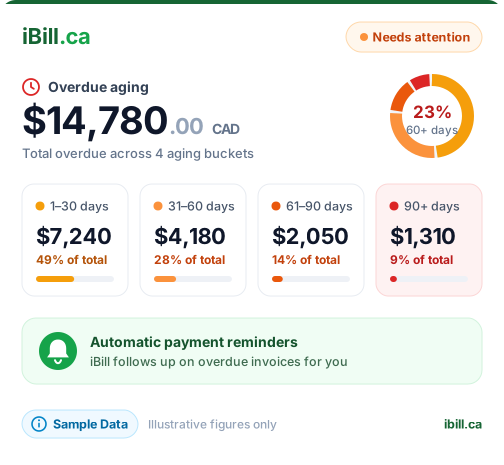
Overdue aging report in iBill (sample data)
1. Setting Clear Payment Terms Upfront
The best way to handle late payments is to prevent them. Clear payment terms set expectations
from the start and give you legal standing if collection becomes necessary.
Essential Payment Terms to Include
Due date: Specify exact payment terms (Net 15, Net 30, Due on Receipt)
Accepted payment methods: Bank transfer, credit card, cheque, e-Transfer
Late payment fees: Clearly state the percentage or fixed fee for overdue invoices
Interest charges: Specify monthly or annual interest rate on overdue amounts
Early payment discounts: Consider offering 2% off for payment within 10 days
Pro Tip: Include your payment terms in your contract or service agreement
AND on every invoice. Having it in writing before work begins makes it legally enforceable.
Common Payment Terms in Canada
Due on Receipt: Payment expected immediately upon receiving invoice
Net 15: Payment due within 15 days - common for small jobs
Net 30: Payment due within 30 days - standard for most businesses
Net 60: Payment due within 60 days - often for large corporations
2/10 Net 30: 2% discount if paid within 10 days, otherwise due in 30
2. Prevention Strategies and Red Flags
The best defence against non-payment is screening clients and structuring projects to minimize risk
before any work begins.
Prevention Checklist
Screen new clients: Check references, look for red flags, and trust your instincts before taking on new work
Get a written contract: Include payment terms, late fees, scope of work, and dispute resolution procedures
Require deposits: 25-50% upfront for new clients or large projects protects against total loss
Invoice promptly: Send invoices immediately upon completion — delays signal that payment is not urgent
Offer multiple payment methods: e-Transfer, credit card, cheque — the easier it is to pay, the faster you get paid
Use milestone billing: Bill as you go for large projects so you are never too far ahead of collected revenue
Track aging invoices: Use invoicing software to monitor overdue accounts and trigger follow-ups automatically
Warning Signs of Problem Clients
Watch for these red flags when evaluating potential clients:
Reluctance to sign a contract or put agreements in writing
Pushing back on deposits or standard payment terms
History of disputes with previous vendors or service providers
Slow to respond to communications during the quoting phase
Constantly changing project scope before work has started
Requesting work before signing agreements or providing a deposit
Trust Your Instincts: If something feels off about a potential client, it is
acceptable to decline the work. The stress of chasing payment often outweighs the value of the project.
3. Sending Payment Reminders
Timely, professional reminders are your first line of defense. Many late payments are simply
oversights, not intentional. A polite reminder is often all it takes.
Recommended Reminder Timeline
3 Days Before Due Date
Send a friendly reminder that payment is coming due. This helps clients who may have
forgotten or need time to process payment.
1-3 Days After Due Date
First overdue notice. Keep it friendly - assume it's an oversight. Include invoice
details and easy payment options.
7 Days Overdue
Second notice. More direct but still professional. Mention that late fees may apply
per your terms.
14 Days Overdue
Third notice. Apply late fees if specified in your terms. Request immediate payment
and ask if there's an issue preventing payment.
30 Days Overdue
Final warning before escalation. State clearly that you will pursue collection or
legal action if payment is not received within a specified timeframe.
iBill.ca Feature: Set up automatic payment reminders to go out before and
after due dates. Keep follow-ups on schedule and save hours of manual tracking.
4. Phone Calls vs. Emails for Collections
Both communication methods have their place in the collection process. Knowing when to use each
improves your chances of getting paid.
When to Use Email
Initial reminders and routine follow-ups
Creating a paper trail (important if you need to escalate to legal proceedings)
Sending copies of invoices and supporting documentation
When you need time to compose a professional, measured message
For clients in different time zones who may not be available by phone
When to Make a Phone Call
After two or more emails have gone unanswered
To understand if there is a dispute about the work or invoice
To negotiate a payment plan or partial settlement
When you have a good relationship with the client and a call feels appropriate
For urgent situations requiring immediate resolution
Document Everything: Keep records of all communication attempts — dates, times,
what was discussed, and any promises made. This documentation is essential if you need to escalate
to a collection agency or court.
5. Adding Late Payment Fees
Late payment fees are legal in Canada, but there are rules you must follow to make them
enforceable.
Legal Requirements for Late Fees in Canada
Must be agreed in advance: Late fees must be stated in your contract or
invoice terms BEFORE providing services. If you are unsure how to structure your terms, our guide on setting freelance rates covers payment terms and late fee policies. You cannot add fees retroactively.
Must be reasonable: Courts may not enforce fees deemed excessive.
Industry standard is 1-2% per month (12-24% annually).
Must be clearly stated: The exact percentage or amount must be specified,
not vague language like "late fees may apply."
Interest Act compliance: Under federal law, interest rates must be stated
as an annual rate. If you charge 2% monthly, state it as "2% per month (24% per annum)."
Typical Late Fee Structures
Flat fee: Fixed amount (e.g., $25) added for any late payment
Percentage: 1-2% of the invoice amount per month
Tiered: Increasing fees the longer payment is overdue (e.g., 1% at 30 days,
1.5% at 60 days)
Important: In Quebec, there are additional consumer protection rules.
Late fees on consumer contracts may be limited. Always consult local regulations for
business-to-consumer transactions.
6. Professional Follow-Up Email Templates
Having professional templates ready saves time and ensures consistent communication.
Customize these for your business:
Friendly First Reminder (1-3 Days Overdue)
Email Template
Subject: Friendly Reminder - Invoice #[NUMBER] Payment Due
Hi [Client Name],
I hope this message finds you well. I wanted to follow up
on Invoice #[NUMBER] for $[AMOUNT], which was due on
[DUE DATE].
If you've already sent payment, please disregard this
message - thank you!
If not, I'd appreciate if you could process this at your
earliest convenience. For easy payment, you can:
- E-Transfer to: [your email]
- Pay online: [payment link if applicable]
Please let me know if you have any questions or if there's
anything I need to clarify about the invoice.
Thank you,
[Your Name]
[Your Business Name]
Second Notice (7 Days Overdue)
Email Template
Subject: Second Notice - Invoice #[NUMBER] Now 7 Days Overdue
Hi [Client Name],
This is a follow-up regarding Invoice #[NUMBER] for
$[AMOUNT], which was due on [DUE DATE] and is now
7 days past due.
As outlined in our payment terms, invoices not paid within
[X] days of the due date are subject to a late fee of
[X]% per month.
Please arrange payment as soon as possible to avoid
additional charges. If there's an issue with the invoice
or if you need to discuss payment arrangements, I'm
happy to talk.
Payment options:
- E-Transfer: [your email]
- Bank Transfer: [details]
- Credit Card: [if applicable]
Thank you for your prompt attention to this matter.
Best regards,
[Your Name]
[Your Business Name]
Final Notice (30 Days Overdue)
Email Template
Subject: URGENT: Final Notice - Invoice #[NUMBER] 30 Days Overdue
Dear [Client Name],
Despite previous reminders, Invoice #[NUMBER] for
$[AMOUNT] remains unpaid, now 30 days overdue.
Current amount owing (including late fees): $[TOTAL]
This is your final notice before we are required to
escalate this matter. If payment is not received within
10 business days, we will have no choice but to:
- Report the debt to credit bureaus
- Engage a collection agency
- Pursue legal action in small claims court
I would prefer to resolve this matter directly. If you're
experiencing financial difficulties, please contact me
immediately to discuss payment arrangements.
To pay now, please use:
- E-Transfer: [your email]
- Direct deposit: [bank details]
Sincerely,
[Your Name]
[Your Business Name]
[Phone Number]
7. When to Escalate to Collections
Knowing when to involve a collection agency is a business decision that weighs the cost of
collection against the amount owed and the likelihood of recovery.
Signs It's Time to Escalate
Invoice is 90+ days overdue with no response to multiple contact attempts
Client is avoiding your calls, emails, and certified letters
Client disputes the work or charges without valid basis
Client has gone out of business or shows signs of financial distress
The amount justifies the cost of collection (typically $500+)
Before Hiring a Collection Agency
Send a formal demand letter via registered mail giving 10-14 days to pay
Document everything: Keep copies of all invoices, emails, contracts, and communication
Attempt a phone call: Sometimes a direct conversation resolves issues
Consider offering a settlement: Accepting 80% now may be better than 50% later
Collection Agency Costs in Canada
Contingency fees: 25-50% of recovered amounts (most common)
Flat fees: $25-100 per account for initial attempts
Legal fees: Additional costs if litigation is required
Choosing a Collection Agency: Look for agencies that are members of provincial
collection associations (like the Ontario Association of Credit Counselling Services) and have
good reviews. Get quotes from at least three agencies.
8. Small Claims Court in Canada
Small claims court is designed for resolving disputes without needing a lawyer. It's a viable
option for unpaid invoices within the monetary limits.
Provincial Small Claims Limits
Province/Territory
Monetary Limit
Filing Fee Range
Ontario
$35,000
$102 - $273
British Columbia
$35,000
$100 - $200
Alberta
$50,000
$100 - $500
Quebec
$15,000
$77 - $188
Manitoba
$15,000
$55 - $100
Saskatchewan
$30,000
$50 - $120
Nova Scotia
$25,000
$99 - $243
New Brunswick
$20,000
$50 - $100
Newfoundland & Labrador
$25,000
$60 - $100
PEI
$16,000
$75 - $150
Steps to File a Small Claims Claim
Gather documentation: Contract, invoices, emails, proof of service
Complete the claim form: Available at your local courthouse or online
Pay the filing fee: Varies by province and claim amount
Serve the defendant: The other party must receive official notice
Attend mediation: Many provinces require mediation before trial
Present your case: Bring all evidence, organized chronologically
Important: Even if you win a judgment, you still need to collect. The court
doesn't collect for you. You may need to garnish wages, seize assets, or file additional
paperwork if the debtor doesn't pay voluntarily.
9. When to Cut Your Losses
Sometimes, pursuing a debt costs more than it is worth. Knowing when to stop chasing and write off
a bad debt is an important business decision.
Consider Writing Off a Debt When:
The amount is small: If the debt is under $500, collection agency fees and legal costs may exceed any recovery
The client has no assets: You cannot collect from someone who has nothing — a court judgment is only as good as the debtor's ability to pay
The client has gone bankrupt: You will need to file as a creditor in their bankruptcy proceedings, and recovery is typically pennies on the dollar
Time spent exceeds the value: Your time has a cost — hours spent on endless chasing may be better invested in finding new clients
Statute of limitations is approaching: In most Canadian provinces, you have 2 to 6 years to pursue a debt in court. Once the limitation period expires, the debt becomes unenforceable
Tax Implications of Bad Debt in Canada
If you use the accrual method of accounting, you may be able to deduct bad debts as a business
expense on your tax return, reducing your taxable income. Under the cash method, you generally
cannot claim a bad debt deduction because you never reported the income in the first place.
Consult with an accountant about proper documentation and timing of the write-off.
For GST/HST registrants, Section 231 of the Excise Tax Act allows you to recover the
GST/HST you remitted on the original sale by claiming an input tax credit on your next GST/HST
return. The adjustment is reported on line 107 of the return. Keep detailed records of your
collection attempts (dates, methods, responses) to support the write-off if CRA audits it.
CRA Documentation: CRA requires that you made reasonable efforts to collect
and that the debt is genuinely uncollectable — not just slow. You must also have previously
included the income in your tax return. Maintain a file of all collection correspondence for
each bad debt you claim.
10. How iBill.ca Helps Track Overdue Invoices
Managing late payments becomes much easier with the right invoicing software.
iBill.ca provides Canadian businesses with powerful tools
to prevent and manage overdue invoices:
Automatic Payment Reminders: Set up automated email reminders before
and after due dates so you never have to manually track follow-ups
Invoice Status Dashboard: See all your invoices at a glance - paid,
unpaid, and overdue - with days outstanding calculated automatically
Overdue Alerts: Get notified immediately when an invoice becomes overdue
so you can take action quickly
Payment History: Track partial payments and maintain a complete record
of all transactions for each client
Client Payment Patterns: Identify which clients consistently pay late
so you can adjust terms or require deposits
Professional Templates: Send polished invoices that clearly display
payment terms, reducing confusion and disputes
Tax-Ready Records: All invoices and payments are automatically organized
for GST/HST reporting - crucial for CRA compliance
Stop Chasing Late Payments
Let iBill.ca automate your invoicing and payment tracking. For Canadian businesses.
Collecting Overdue Payments in Canada: Legal Limits, Liens, and Bad Debt Recovery
When standard reminders fail and an invoice remains unpaid for 60, 90, or 120+ days, Canadian businesses need to understand the legal tools and financial recovery options available to them. From interest rate limits set by federal law to provincial lien rights and CRA bad debt provisions, knowing your options — and their costs — helps you make informed decisions about escalation.
Interest Rate Legality in Canada
The Criminal Code of Canada (Section 347) caps interest at an effective annual rate of 60%. Charging more than this is a criminal offence, not just a civil matter. For commercial invoices, typical late-payment interest rates fall between 1.5% and 2% per month (18% to 24% annually). The federal Interest Act requires that any interest rate be expressed as an annual percentage — stating "2% per month" without also noting "24% per annum" can render the interest clause unenforceable. Always include both the monthly and annual rate on your invoices and in your contracts. If you did not specify an interest rate in your original agreement, you can still claim pre-judgment interest in court, but the rate will default to provincial rules, which are typically much lower (often 2% to 5% annually).
Collection Agency Process and Costs
Engaging a collection agency is a significant step. Once you assign a debt to an agency, they contact the debtor on your behalf through calls, letters, and sometimes skip tracing. Agencies in Canada must comply with provincial collection agency licensing requirements and follow strict rules about contact frequency and conduct. Fees are typically structured as contingency — the agency collects 25% to 50% of the recovered amount, with older debts and smaller balances commanding higher percentages. Some agencies offer flat-fee "demand letter" services at $25 to $100 per account as a first step before full collection. Be aware that assigning a debt to collections can damage your relationship with the client permanently, so this is best reserved for situations where the relationship is already lost.
Small Claims Court Limits by Province
Small claims court is designed for individuals and small businesses to resolve disputes without hiring a lawyer. The monetary limits vary significantly: Ontario allows claims up to $35,000, British Columbia up to $5,000 (with the Civil Resolution Tribunal handling claims up to $5,000 online), Alberta up to $50,000, and Quebec up to $15,000 in the Small Claims Division. Filing fees range from $50 to $500 depending on the province and claim amount. The process typically takes 3 to 8 months from filing to hearing. You represent yourself, bring your documentation (contract, invoices, emails, proof of delivery), and the judge renders a decision. Winning a judgment and collecting on it are two separate challenges — if the debtor does not pay voluntarily, you may need to garnish wages or seize assets through additional court processes.
Mechanic's Lien and Builder's Lien
Contractors, subcontractors, and material suppliers have a powerful tool that other businesses do not: the right to file a lien against the property where they provided work or materials. Each province has its own lien legislation with strict deadlines. In Ontario, you must preserve your lien within 60 days of last supplying services or materials. In British Columbia, the deadline is 45 days. In Alberta, it is 60 days from substantial completion. A registered lien encumbers the property title, which means the property cannot be sold or refinanced without addressing the lien. This gives you significant leverage, but missing the filing deadline extinguishes the right entirely. If you work in construction, track lien deadlines as carefully as you track invoice due dates.
CRA Bad Debt Write-Off and GST/HST Recovery
When an invoice is genuinely uncollectable, you can write it off as a bad debt expense, reducing your taxable income. CRA requires that you made reasonable efforts to collect and that the debt is actually uncollectable — not just slow. You must also have previously included the income in your tax return. For GST/HST registrants, Section 231 of the Excise Tax Act allows you to recover the GST/HST you remitted on the original sale by claiming an input tax credit on your next GST/HST return. The adjustment is reported on line 107 of the GST/HST return. Keep detailed records of your collection attempts (dates, methods, responses) to support the write-off if CRA audits it.
How long should I wait before following up on an unpaid invoice in Canada?
Send a friendly reminder 1-3 days after the due date. If there's no response, follow up
with a more formal reminder at 7 days, then 14 days, and 30 days. Most Canadian businesses
consider an invoice seriously overdue after 30 days.
Are late payment fees legal in Canada?
Yes, late payment fees are legal in Canada, but they must be reasonable and clearly stated
in your payment terms before providing services. Typical late fees range from 1-2% per month.
The fee must be agreed upon in advance to be enforceable.
What is the small claims court limit in Canada?
Small claims court limits vary by province: Ontario ($35,000), BC ($35,000), Alberta ($50,000),
Quebec ($15,000), Manitoba ($15,000), Saskatchewan ($30,000), Nova Scotia ($25,000), and other
provinces range from $10,000-$50,000. Check your province's specific limit.
Can I charge interest on overdue invoices in Canada?
Yes, you can charge interest on overdue invoices if it was agreed upon in your terms. The
federal Interest Act limits interest to a maximum annual rate that must be clearly stated.
Common practice is 1-2% monthly (12-24% annually). Without pre-agreed terms, the Bank of
Canada rate applies.
When should I send an invoice to collections in Canada?
Consider sending to collections after 90 days of non-payment and multiple failed contact
attempts. Before doing so, send a final demand letter giving 10-14 days to pay. Collection
agencies typically charge 25-50% of recovered amounts.
How do I write a professional payment reminder email?
Keep it professional and factual. Include the invoice number, amount due, original due date,
and days overdue. Offer easy payment options and ask if there are any issues. Avoid accusatory
language - assume it's an oversight until proven otherwise.
What should I do before sending an invoice to collections?
Before using a collection agency: send a formal demand letter via registered mail, document
all communication attempts, verify the client's contact information is correct, confirm there
are no disputes about the work or services, and give a final deadline (usually 7-14 days)
to pay before proceeding.
Can I write off a bad debt on my Canadian taxes?
If you use the accrual method of accounting, you can deduct genuinely uncollectable debts as
a business expense. CRA requires that you made reasonable collection efforts and that the income
was previously reported. GST/HST registrants can also recover remitted tax on bad debts by
claiming an input tax credit on line 107 of their GST/HST return.
What are the warning signs of a client who may not pay?
Red flags include reluctance to sign a contract, pushing back on deposits or payment terms,
a history of disputes with previous vendors, slow responses during the quoting phase, constantly
changing project scope, and requesting work before signing agreements. If you notice multiple
warning signs, consider requiring full payment upfront or declining the project.