iBill.ca
Get Started
🦷 Built for Dental Professionals

Dentist Invoice Software for Canadian Dental Clinics

Professional invoicing for Canadian dentists and dental clinics. Create procedure-based invoices, support insurance claims, and track treatment plans. Most dental services are GST-exempt - we handle it automatically.

All-in-One
Platform
Unlimited Invoices
13
Provinces Supported

Features Dental Practices Actually Need

Invoice software designed for how dental clinics really work

📋

Procedure-Based Billing

Create invoices with dental procedure codes, tooth numbers, and detailed treatment descriptions. Itemize each service for clear patient understanding and insurance submission.

📄

Insurance Claim Support

Generate detailed invoices that patients can submit to their insurance providers. Include all necessary information - procedure codes, dates, and itemized costs for smooth claims processing.

📅

Treatment Plan Tracking

Track multi-stage treatment plans across multiple visits. Invoice for orthodontics, implants, or complex restorations with clear references to the overall treatment plan.

👤

Patient Records

Store patient details, billing history, and treatment records. Quickly invoice returning patients without re-entering their information every appointment.

🧾

GST Exemption Handling

Most dental services are GST/HST-exempt in Canada. iBill.ca lets you mark services as tax-exempt or taxable (for cosmetic procedures) with one click.

📊

Revenue Reports

Track collections, outstanding balances, and procedure revenue. Generate reports for practice management and financial planning.

Dentists: Create Professional Invoices in 60 Seconds

iBill creates CRA-ready invoices for dental services with automatic tax calculations and professional PDF export.

Create Invoice
Trusted by Canadian Businesses — 1,200+ signups

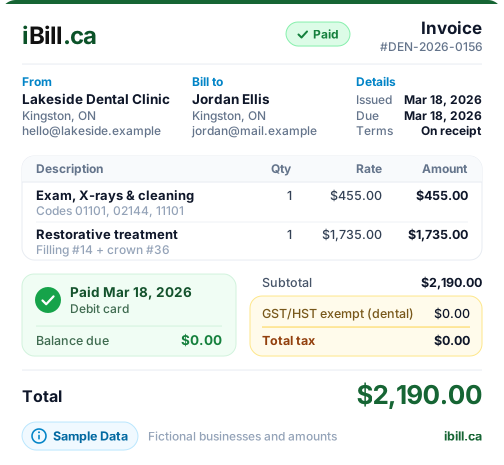
Sample Dental Invoice

Here's what your professional dental invoice will look like

Invoice #DEN-2024-0156 - Comprehensive Dental Treatment

Procedure Code Description Tooth Amount
01101 Complete Oral Examination - $85.00
02144 Full Mouth X-rays (FMX) - $175.00
11101 Scaling and Polishing (Cleaning) - $195.00
21222 Composite Filling - 2 surfaces #14 $285.00
27201 Porcelain Crown - Full #36 $1,450.00
Subtotal: $2,190.00
GST/HST (Exempt): $0.00
Total: $2,190.00

For Insurance Claims: Please submit this invoice to your insurance provider along with your policy number. Patient ID: PT-2024-0892 | Provider: Dr. Sarah Chen, DDS | License #12345

Why Dentists Choose iBill.ca

💰

Included

No monthly fees, no per-invoice charges. Keep more of your practice revenue.

🍁

Made for Canada

Built for Canadian dental practices with proper GST exemption handling.

📄

Insurance-Ready

Invoices include all details needed for patient insurance submissions.

🔒

Secure & Private

Patient data is encrypted and protected. Your practice data stays private.

🦷

Procedure Codes

Add dental procedure codes for clear, professional invoices.

🔄

Patient History

See past invoices, payments, and treatment history for each patient.

Invoice Any Dental Service

From routine checkups to complex procedures

🔍

Exams

Oral exams, consultations

Cleanings

Scaling, polishing, deep cleaning

🦷

Fillings

Composite, amalgam

👑

Crowns

Porcelain, metal, ceramic

💧

Root Canals

Endodontic treatment

🔨

Extractions

Simple, surgical

Whitening

In-office, take-home

💪

Orthodontics

Braces, aligners

Dental Invoice FAQs

Do dentists need to charge GST/HST on dental services in Canada?
Most dental services in Canada are GST/HST-exempt as they are considered basic health care services. This includes examinations, cleanings, fillings, extractions, root canals, and other medically necessary procedures. However, cosmetic procedures like teeth whitening may be taxable. iBill.ca allows you to mark services as tax-exempt or taxable as needed.
What is the best invoice software for dental clinics in Canada?
iBill.ca is an invoice software designed for Canadian dental practices. It supports procedure-based billing with dental codes, patient record management, and insurance-friendly invoices. Create professional invoices that help patients submit claims to their insurance providers.
How do I create invoices for dental insurance claims?
iBill.ca allows you to create detailed invoices with procedure codes, tooth numbers, and treatment descriptions that patients can submit to their insurance providers. Include all necessary information like patient details, date of service, procedure codes, and itemized costs to facilitate insurance reimbursement.
Can I track treatment plans and multiple visits with iBill.ca?
Yes, iBill.ca supports treatment plan tracking across multiple visits. Create invoices for each appointment, reference the overall treatment plan, and track patient payment history. Perfect for multi-stage procedures like orthodontics, implants, or crown work.
Does iBill.ca work for dental practices?
Yes, iBill.ca is for Canadian dentists and dental clinics. Create unlimited invoices, manage patients, track payments, and generate reports.

Ready to streamline your dental practice invoicing?

Create Invoice

Dental Practice Billing in Canada: What Every Dentist Needs to Know

Dental billing in Canada operates under a unique set of rules that sets it apart from virtually every other profession. Most dental services are GST/HST-exempt because they qualify as basic health care, yet cosmetic procedures like teeth whitening, veneers for purely aesthetic reasons, and certain orthodontic treatments may be taxable. This means a single patient visit can generate an invoice with both exempt and taxable line items, requiring careful categorization on every bill. Dentists who also offer wellness services similar to those provided by a massage therapist or other health practitioners need to understand where the CRA draws the line between exempt and taxable health services.

Procedure-Based Billing and Insurance Coordination

Canadian dental invoices are built around procedure codes from the provincial dental fee guides. Each procedure -- from a unit of scaling (code 11101) to a porcelain-fused-to-metal crown (code 27201) -- has a suggested fee that varies by province. Your invoices should reference the procedure code, tooth number (using the FDI universal numbering system), and a plain-language description so that patients can understand their charges and submit claims to their insurers. When a patient has dual coverage from two insurance plans, your office may need to issue separate invoices or provide a detailed breakdown that each insurer can process independently. Offering patients access to their billing history through a client portal reduces phone calls and simplifies the resubmission process for rejected claims.

Lab Fees, Materials, and Pass-Through Costs

Dental labs charge for crowns, bridges, dentures, night guards, and other custom-fabricated appliances. These lab fees are typically passed through to the patient as a separate line item on the invoice, often with a markup to cover shipping, quality control, and chair time for adjustments. Implant components, bone grafting materials, and specialized surgical supplies are handled similarly. Being transparent about lab and material costs on your invoices builds patient trust and provides documentation they may need for insurance appeals or personal tax records. Proper payment tracking across lab invoices, patient payments, and insurance reimbursements is essential for reconciling your accounts receivable.

Patient Payment Plans and Hygiene Appointment Billing

For expensive treatment plans -- orthodontics, full-mouth rehabilitations, or implant-supported prosthetics -- many dental practices offer payment plans that spread the total cost across several months. Each payment should generate its own invoice or receipt, referencing the original treatment plan and showing the running balance. Routine hygiene appointments, which form the backbone of recurring revenue for most practices, are ideal candidates for standardized invoice templates that include the patient's recall schedule and next appointment date. Keeping meticulous records for Canadian tax purposes ensures your practice can withstand a CRA review while also giving patients the documentation they need for their own health expense claims.

Co-Pay Tracking, Orthodontic Payment Plans, and Lab Fee Management for Canadian Dental Practices

Patient co-pay tracking is one of the most administratively demanding aspects of dental billing in Canada, because unlike many other health professions, dental insurance rarely covers 100% of a procedure. A typical employer-sponsored plan might cover 80% of basic services (cleanings, fillings, extractions), 50% of major services (crowns, bridges, root canals), and 0% of elective cosmetic work. This means your invoice for a single appointment might need to show the total fee based on the provincial fee guide, the estimated insurance portion, and the patient's co-pay responsibility -- all before the insurance company has actually adjudicated the claim. When the insurer pays a different amount than estimated (which happens frequently due to fee guide discrepancies, annual maximums being reached, or procedures being downgraded), you need to issue an adjusted invoice or statement showing the revised patient balance. Practices that fail to track these co-pay adjustments systematically end up with thousands of dollars in uncollected patient balances that are nearly impossible to recover after six months.

Insurance Assignment and Predetermination Billing

Assignment of benefits -- where the insurance company pays the dental office directly instead of reimbursing the patient -- simplifies collections but adds invoicing complexity. When you accept assignment, your invoice effectively has two payors: the insurer and the patient. The initial invoice goes to the insurance company with the patient's group number, certificate number, and a detailed procedure breakdown using the standard CDA procedure codes. Once the insurer pays their portion, you issue a patient statement showing the original charge, the insurance payment received, and the remaining balance due. For procedures over $500, many insurers require a predetermination before treatment, which is essentially an invoice for work not yet performed. Your predetermination submission must include the same procedure codes, fee guide amounts, and clinical justification (often with X-rays) as the actual claim. Maintaining clean records of predeterminations alongside actual invoices is essential for reconciling what was approved versus what was ultimately billed. This dual-payor complexity is unique to dental and is why payment tracking is non-negotiable for any practice serving insured patients.

Orthodontic Payment Plans: Multi-Year Billing Structures

Orthodontic treatment represents the most complex long-term billing arrangement in dentistry. A comprehensive orthodontic case -- traditional braces or clear aligners -- typically costs $5,000 to $9,000 in Canada and spans 18 to 30 months. The standard billing structure involves three phases: a records and consultation fee ($250 to $500, sometimes waived if treatment proceeds), an initial payment at banding or aligner delivery (30% to 50% of the total), and the remaining balance divided into equal monthly payments across the active treatment period. Each monthly payment must generate an invoice or receipt that shows the payment amount, the original treatment plan total, cumulative payments to date, and the outstanding balance. This is critical because patients frequently submit individual monthly receipts to their insurance for reimbursement up to their annual orthodontic maximum. If a patient's plan covers $2,500 for orthodontics over a lifetime, they might submit $1,250 in year one and $1,250 in year two -- your invoicing must support this by issuing receipts aligned with the calendar year, not the treatment timeline.

When patients discontinue treatment early or transfer to another orthodontist, your final invoice must clearly document the percentage of treatment completed, the amount already paid, any refund owed (typically calculated proportionally), and the clinical status at the time of discontinuation. This documentation protects the practice from disputes and provides the receiving orthodontist with the billing history they need to structure their own fees.

Lab Fee Pass-Through and Material Cost Documentation

Dental laboratory fees for crowns, bridges, implant abutments, dentures, and night guards represent a significant pass-through cost that requires careful invoice documentation. A porcelain crown from a Canadian dental lab costs the practice $200 to $450 depending on the material (zirconia, lithium disilicate, or porcelain-fused-to-metal) and the lab's turnaround time (rush fees add 30% to 50%). The patient's invoice typically shows the crown procedure fee from the fee guide (which includes the lab component) rather than itemizing the lab fee separately. However, if the patient requests premium materials -- a high-translucency zirconia crown instead of standard PFM, for example -- the lab fee differential should appear as a separate upgrade charge on the invoice. Implant components are even more variable: a titanium abutment might cost $150 while a custom zirconia abutment runs $400 to $600. These material cost differences must be documented on the invoice because insurance companies routinely deny upgraded material charges if the clinical justification is not provided. Tracking lab expenses as a practice overhead through expense management ensures your fee guide charges actually cover your real lab costs -- a surprising number of practices discover their crown fees have not kept pace with lab price increases, eroding margins on one of their most common procedures.

Ready to Simplify Your Dental Billing?

Canadian dental practices use iBill.ca to create professional invoices. Easy to use, insurance-friendly.

Create Account

| Unlimited Invoices | Insurance-Ready

Related Resources

All Industries Massage Therapist Invoice Templates