
Double-Entry Accounting Software for Canadian Businesses
Every transaction automatically creates matching debit and credit entries — keeping your books balanced and CRA-ready without manual journal entries.
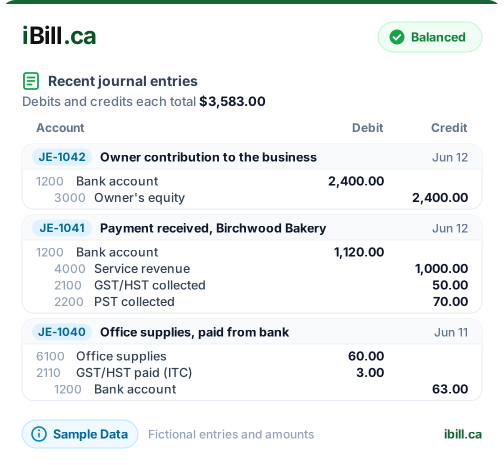
What is Double-Entry Accounting?
The gold standard of bookkeeping — used by businesses worldwide to maintain accurate, verifiable financial records
Every transaction is recorded in two accounts — one debited and one credited — so the books always balance. If you receive a $1,000 payment, your bank account increases (debit) and your revenue increases (credit) by the same amount.
Why does this matter? Double-entry accounting prevents errors, creates a complete audit trail, and ensures your financial statements are always accurate. If debits do not equal credits, you know something is wrong before it becomes a tax filing problem.
How iBill automates it: You do not need to understand debits and credits. iBill automatically posts balanced journal entries every time you record a payment, log an expense, issue a refund, or depreciate an asset. The system handles the accounting — you focus on your business.
The CRA expects accurate books from GST/HST registrants and incorporated businesses. Double-entry accounting gives you the verifiable records needed for compliance, and iBill makes it effortless.
How iBill Automates Double-Entry
Every financial event triggers balanced journal entries — no manual posting required
Client Pays Invoice
Cash received is recorded with tax automatically split into the correct liability accounts.
Business Purchase Made
Expense categorized with input tax credits (ITCs) separated for CRA reporting.
Payment Reversed
Proportional reversal of revenue and tax — matches the original entry exactly.
Payment Before Invoice
Cash received is held in unearned revenue until the invoice is created.
Annual Asset Depreciation
Capital cost allowance calculated per CRA rules and posted to the general ledger.
Your Books, Always Balanced
Double-entry accounting that runs itself. Every transaction auto-posts balanced journal entries.
Create AccountKey Capabilities
Everything you need for proper double-entry accounting — built into iBill and fully automated
Automated Journal Entries
Every payment, expense, and refund automatically creates balanced debit/credit entries in your general ledger. No manual posting.
General Ledger
Complete transaction history with drill-down into individual journal entries. Filter by date, account, or transaction type to find exactly what you need.
Trial Balance
Real-time verification that debits equal credits across all accounts. If something is off, you will know immediately — not at year-end when it is too late.
Bank Reconciliation
Match your general ledger entries against bank statements. Auto-categorize recurring transactions and flag discrepancies before they become problems.
Multi-Account Tracking
Full chart of accounts covering Assets, Liabilities, Equity, Revenue, and Expenses. Pre-configured for Canadian businesses with GST/HST accounts built in.
Audit Trail
Sequential entry numbers, timestamps, and transaction references on every journal entry. Complete history that satisfies CRA record-keeping requirements.
Who Needs Double-Entry Accounting?
Whether you are just starting out or scaling up, double-entry keeps your finances organized and CRA-ready
Incorporated Businesses
Corporate accounting requires proper double-entry bookkeeping. iBill gives you a full general ledger with balanced journal entries for every transaction — ready for your accountant at year-end.
GST/HST Registrants
Track tax collected versus input tax credits accurately. Double-entry ensures your HST payable account always reflects exactly what you owe the CRA — no guesswork at filing time.
Businesses with Assets
Capital cost allowance (CCA) depreciation needs proper GL tracking. iBill records asset acquisitions, annual depreciation, and disposals with correct journal entries for each CRA class.
Growing Businesses
Scale from simple invoicing to full accounting seamlessly. iBill grows with you — start with basic invoicing and the double-entry system tracks everything behind the scenes from day one.
Double-Entry Accounting FAQs
Ready to automate your accounting with double-entry bookkeeping?
Create AccountStart Managing Your Books with Confidence
Trusted by Canadian businesses using iBill's double-entry accounting.
Create AccountUnlimited Invoices • CRA-Ready