iBill.ca
Get Started
🔨 Built for Carpenters

Carpenter Invoice Software That's Easy

Professional invoicing for Canadian carpenters and woodworkers. Track lumber, hardware, and labour hours. Automatic GST/HST calculation for every province. CRA-ready invoices.

All-in-One
Platform
Unlimited Invoices
13
Provinces Supported

Features Carpenters Actually Need

Invoice software designed for how woodworking professionals really work

🪵

Materials + Hardware + Labour

Create separate line items for lumber (hardwoods, plywood, dimensional), hardware (hinges, drawer slides, screws), and labour hours. Show customers exactly what they're paying for.

📂

Custom Millwork Pricing

Quote custom cabinets, built-ins, and furniture with detailed breakdowns. Add per-linear-foot pricing for trim, crown moulding, and baseboards.

🧾

Automatic Tax Calculation

GST, HST, PST - calculated automatically based on your client's province. 13% HST in Ontario, 5% GST + 7% PST in BC. Never look up tax rates again.

💰

Deposit & Progress Invoicing

Create deposit invoices for custom work (30-50% upfront). Track progress payments on larger projects and show remaining balance on final invoices.

👤

Client Database

Store client details, project notes, and job history. Quickly invoice repeat customers and track past work for referrals and follow-up projects.

📊

Tax Reports for CRA

Generate GST/HST reports for quarterly or annual filing. Track how much tax you've collected and simplify your CRA paperwork.

Carpenters: Create Professional Invoices in 60 Seconds

iBill creates CRA-ready invoices for carpentry work with automatic tax calculations and professional PDF export.

Create Invoice
Trusted by Canadian Businesses — 1,200+ signups

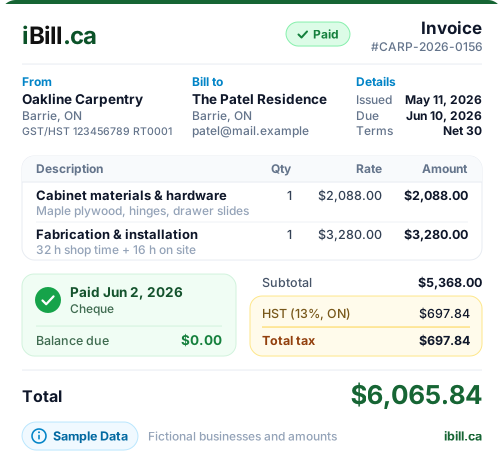
Sample Carpenter Invoice

Here's what your professional carpentry invoice will look like

Invoice #CARP-2024-0156 - Custom Kitchen Cabinet Installation

Description Qty Rate Amount
Materials
3/4" Maple Plywood (cabinet boxes) 8 sheets $95.00 $760.00
Solid Maple (doors & drawer fronts) 40 bd ft $12.50 $500.00
Hardware
Soft-Close Hinges (Blum) 24 $8.50 $204.00
Full-Extension Drawer Slides 12 pairs $32.00 $384.00
Cabinet Pulls (brushed nickel) 20 $12.00 $240.00
Labour
Cabinet Fabrication (shop time) 32 hrs $65.00 $2,080.00
On-Site Installation 16 hrs $75.00 $1,200.00
Subtotal: $5,368.00
Deposit Received: -$2,000.00
HST (13%): $437.84
Balance Due: $3,805.84

Notes: Cabinets finished with 3 coats water-based lacquer. 1-year warranty on craftsmanship. Hardware covered by manufacturer warranty.

Why Carpenters Choose iBill.ca

💰

Included

No monthly fees, no per-invoice charges. Keep more of what you earn.

🍁

Made for Canada

Built for Canadian tax rules and how carpenters work here.

Quick Invoicing

Create professional invoices on the job site from your phone or tablet.

🔒

Secure & Private

Your business data is encrypted in transit and at rest. We don't sell your data — see our Privacy Policy.

📋

CRA Ready

Invoices include all CRA-required fields for GST/HST registrants.

🔄

Project History

Track past projects and easily create quotes for similar work.

Invoice Any Type of Carpentry Work

From custom cabinets to full renovations

📦

Custom Cabinets

Kitchen, bathroom, built-ins

📐

Trim Work

Crown, baseboards, casing

🏠

Framing

New construction, additions

🏝

Decks

Outdoor living, pergolas

🪑

Custom Furniture

Tables, shelving, desks

🔧

Renovations

Kitchens, bathrooms, basements

🚪

Stairs & Railings

Custom staircases, handrails

📚

Built-ins

Bookcases, entertainment units

Carpenter Invoice FAQs

What is the best invoice software for carpenters in Canada?
iBill.ca is an invoice software designed for Canadian carpenters and woodworkers. It allows you to create professional invoices with separate line items for materials, hardware, and labour, track custom projects, and automatically calculate GST/HST/PST. All features included.
How do carpenters invoice for materials and labour separately?
With iBill.ca, you can add multiple line items to each invoice. Create separate entries for lumber (hardwoods, plywood, dimensional lumber), hardware (hinges, drawer slides, fasteners), and labour hours. You can set different rates for shop time vs. on-site work and include markup on materials as needed.
How should carpenters handle deposits for custom work?
For custom cabinetry and millwork, it's common to request a deposit (typically 30-50%) before starting. iBill.ca allows you to create deposit invoices and track partial payments. The final invoice can show the deposit received and remaining balance, making the payment process clear for both you and your client.
Do carpenters need to charge GST/HST on their invoices?
If your carpentry business earns more than $30,000 per year, you must register for GST/HST and charge it on your invoices. iBill.ca automatically calculates the correct tax rate based on your client's province - 13% HST in Ontario, 5% GST + 7% PST in BC, and so on.
Does iBill.ca work for carpenters and woodworkers?
Yes, iBill.ca is for Canadian carpenters. Create unlimited invoices, manage clients, track payments, and generate tax reports. No surprises.

Ready to streamline your carpentry business invoicing?

Create Invoice

Why Carpentry Professionals in Canada Need Dedicated Invoice Software

Carpentry spans one of the widest ranges of work in the Canadian trades, from custom furniture building in a workshop to full-scale renovation framing on a construction site. A cabinetmaker producing a set of custom kitchen cabinets might spend three weeks on a single $8,000 to $15,000 project with carefully tracked material costs, while a renovation carpenter might invoice four different homeowners in the same week for trim work, deck builds, door installations, and basement framing. Each of these jobs has a fundamentally different cost structure -- custom furniture is materials-heavy with precise waste tracking, while renovation carpentry is labour-intensive with materials often supplied by the general contractor or homeowner. Your invoicing needs to handle both extremes and everything in between.

The materials-versus-labour breakdown is where carpentry invoicing gets particularly detailed. A custom built-in bookshelf might require $600 in hardwood lumber, $150 in plywood for backing and shelves, $80 in hardware and fasteners, $40 in finishing materials like stain and polyurethane, and 30 hours of shop and installation labour at $55 to $85 per hour. If your invoice shows only a single lump sum of $3,370, neither you nor the client can evaluate whether the pricing is fair. More importantly, you cannot look back at completed projects to determine your actual material-to-labour ratio for future quotes. Trades like painting contractors and electricians face this same transparency challenge, but carpentry materials -- especially hardwoods and specialty plywood -- have some of the highest price volatility due to lumber market fluctuations, making historical cost tracking essential for accurate quoting.

Subcontractor Billing and Project Milestone Invoicing

Many carpentry businesses reach a point where they take on projects large enough to require subcontractors -- a finishing carpenter might sub out the rough framing, or a renovation carpenter might bring in a specialized stair builder. Managing subcontractor costs and billing them through to the end client requires invoicing that clearly distinguishes your own labour from subcontracted work. From a CRA perspective, any subcontractor you pay more than $500 in a year should receive a T4A slip, and maintaining clean invoice records for both incoming and outgoing payments simplifies this annual reporting requirement significantly. Understanding invoice numbering best practices becomes critical when you are tracking both client invoices and subcontractor payment records within the same system.

Larger carpentry projects -- a kitchen renovation, a deck build, a basement finishing -- naturally call for milestone-based invoicing rather than a single invoice at project completion. A typical structure might be 25% deposit to secure the start date and order materials, 25% after rough framing or demolition is complete, 25% at the midpoint when cabinets or major components are installed, and the final 25% upon completion and client walkthrough. Each milestone invoice needs to reference the original quote, show the cumulative amount paid to date, and clearly state the remaining balance. Using a project management approach to your invoicing ensures that no milestone gets missed, materials are paid for before you install them, and the client always knows exactly where they stand financially throughout the project -- reducing the payment disputes that plague carpentry businesses operating on handshake agreements and lump-sum billing.

Finish vs. Framing Rates, Design Consultations, and Cost-Plus Billing for Canadian Carpenters

The rate differential between rough framing and finish carpentry is one of the most significant pricing factors in the trade, yet many carpenters undercharge for their finishing work by applying a single blended rate across all services. Rough framing -- wall framing, floor joists, roof trusses -- is physically demanding production work that typically bills at $45 to $70 per hour in most Canadian markets. Finish carpentry -- crown moulding installation, custom trim work, built-in cabinetry fitting, staircase handrails, and wainscoting -- demands precision measured in fractions of a millimetre and bills at $65 to $110 per hour depending on the complexity and the carpenter's reputation. Your invoice must clearly distinguish between these rate tiers when a single project involves both rough and finish work. A basement renovation, for example, might include 20 hours of framing at $55/hour and 15 hours of trim and finishing at $85/hour. Blending these into a single rate of $67/hour undervalues the finish work and makes it impossible to evaluate profitability by service type. This rate differentiation is similar to how electricians separate apprentice and journeyman labour rates on the same invoice.

Site Measurement and Design Consultation Fees

Many carpenters give away two of their most valuable services for free: site measurements and design consultations. A proper site measurement for a kitchen cabinet installation, a built-in entertainment unit, or a custom closet system takes 1 to 3 hours when done correctly -- measuring wall dimensions, checking for plumb and level, noting electrical and plumbing locations, photographing existing conditions, and documenting any structural concerns. This information is essential for accurate quoting and fabrication, and it has real value. Charging a site measurement fee of $100 to $250 (often credited toward the project if the client proceeds) filters out casual inquiries from serious clients. Your invoice for the measurement visit should itemize the service clearly: "On-site measurement and assessment -- 2.5 hours including documentation and preliminary layout sketches." If the client proceeds, your project invoice shows a credit line: "Site measurement fee (applied to project) -$150." This approach is professional, transparent, and positions your expertise as valuable from the first interaction.

Design consultation fees apply when clients want your input on layout, material selection, or aesthetic decisions before committing to a project. A carpenter with 15 years of experience selecting hardwoods, designing functional storage solutions, and understanding how different joinery techniques affect both cost and appearance is providing design expertise that architects and interior designers charge $100 to $200 per hour for. Billing $75 to $125 per hour for design consultation -- separate from any construction work -- establishes the value of your knowledge and ensures you are compensated even if the client ultimately decides not to proceed. Document these consultations with detailed notes that become part of the project file, referencing the original consultation invoice number on subsequent project invoices.

Cost-Plus Billing and Lumber Price Volatility

Cost-plus billing (also called time-and-materials) is the preferred invoicing model for carpentry projects where the scope cannot be fully defined upfront -- heritage home restoration, custom furniture where design evolves during fabrication, or renovation work where hidden conditions only reveal themselves once demolition begins. Under cost-plus, your invoice shows the actual material receipts (lumber, hardware, finishing products) plus a predetermined markup (typically 15% to 25%) plus labour hours at your agreed rate. This model demands meticulous record-keeping: every trip to the lumber yard generates a receipt that must be captured and matched to the project. Canadian lumber prices can swing 30% to 50% in a single year -- a sheet of 3/4-inch Baltic birch plywood that cost $65 in 2024 might be $95 in 2026 -- making fixed-price quotes on material-heavy projects risky. Cost-plus invoicing transfers that price volatility risk to the client while keeping your margins consistent. Each invoice should include scanned or photographed material receipts as supporting documentation. Tracking these material purchases through proper record-keeping practices ensures you can substantiate every charge if a client questions the bill and provides clean CRA documentation for your input tax credit claims on materials purchased.

Ready to Invoice Like a Pro?

Canadian carpenters use iBill.ca to create professional invoices. Easy to use, CRA-ready.

Create Account

Unlimited Invoices | CRA-Ready

Related Resources

All Industries Contractor Template Painter Invoicing