
How Canadian Bookkeepers Should Structure Their Client Billing
Bookkeepers occupy a unique position in the invoicing world: you are the professional who teaches clients how important proper invoicing is, yet your own billing practices must be equally impeccable. Whether you serve five clients or fifty, having a clear billing structure prevents scope creep, reduces payment disputes, and projects the professionalism your clients expect from their financial partner.
Monthly Retainer vs. Per-Transaction Pricing
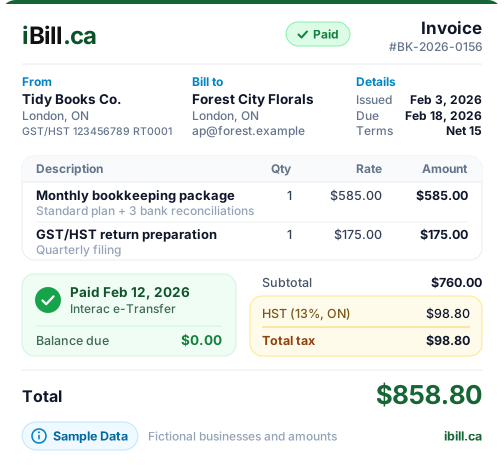
The most common billing model for Canadian bookkeepers is a monthly retainer, typically ranging from $300 to $1,500 depending on transaction volume and complexity. A well-structured retainer invoice should itemize each service component: base bookkeeping, bank reconciliations, accounts payable processing, and HST filing preparation. This transparency builds trust and makes it easier to justify rate increases as the business grows. For newer or smaller clients, per-transaction pricing can be an effective entry point. Some bookkeepers charge $2 to $5 per transaction with a monthly minimum. This model aligns your revenue directly with workload, which is particularly fair for seasonal businesses. Like accountants, bookkeepers should clearly separate advisory work from routine data entry on every invoice.
Year-End Preparation and Payroll Processing
Year-end work deserves its own invoice or, at minimum, its own section on your monthly invoice. T4 preparation, T5 slips, ROE generation, and financial statement compilation are all distinct services with distinct value. Canadian bookkeepers typically charge $15 to $25 per T4 and $150 to $500 for year-end financial statement preparation, depending on entity complexity. Payroll processing is another revenue stream that should be invoiced clearly. Your invoice should show the per-run fee, the number of employees processed, and any additional services such as ROE filings or CRA remittance preparation. Maintaining thorough records for Canadian tax purposes is not just advice you give clients; it applies equally to documenting your own service delivery.
Software Subscriptions and Multi-Entity Billing
Many bookkeepers purchase accounting software subscriptions on behalf of their clients and pass through the cost. When doing so, list the software fee as a separate line item and consider adding a small administration markup to cover your time managing the subscription. Your financial ledger should track these pass-through costs separately from your professional service revenue. For clients who operate multiple entities, such as a holding company and an operating company, billing can become complex. The cleanest approach is to invoice each entity separately, even if the same contact pays both. This keeps your records aligned with theirs and avoids confusion when their external consultants or auditors review the books. Setting clear payment terms in your engagement letter, typically Net 15 for bookkeeping clients, ensures cash flow remains healthy even as your practice scales.