iBill.ca
Get Started
Sole Proprietor Templates

Self-Employed Invoice Template Canada

Professional invoice templates built for self-employed Canadians. Automatic GST/HST calculation, CRA-ready format, and business expense tracking.

$30K
GST Registration Threshold
100%
CRA Ready
All-in-One
Platform

Templates for Every Self-Employed Canadian

No matter your business, we have the right invoice template for you

Consultants

Business, IT, management

Coaches

Life, business, fitness

Tutors

Academic, music, language

Tradespeople

Plumbers, electricians

Home Services

Cleaning, landscaping

Personal Care

Beauty, massage, wellness

E-commerce

Online sellers, Etsy shops

Drivers

Delivery, rideshare, courier

Food Services

Catering, personal chefs

Pet Services

Walking, grooming, sitting

How to Create Your First Self-Employed Invoice

New to self-employment? Follow these 4 simple steps to invoice like a pro

1

Set Up Your Profile

Enter your business name (or personal name), address, phone, and email. Add your GST/HST number if registered.

2

Add Client Details

Enter your client's name, company (if applicable), billing address, and contact info for your records.

3

List Your Services

Describe the work performed, add quantities, rates, and any materials. Be specific to avoid disputes.

4

Send & Track

Download PDF or email directly. iBill tracks payment status and sends reminders for overdue invoices.

Create Your First Invoice

GST/HST Registration for Self-Employed

Understand when you need to register and start charging tax

The $30,000 Threshold

You must register for GST/HST if your business revenue exceeds $30,000 over four consecutive calendar quarters.

Example: If you earn $8,000/quarter for 4 quarters ($32,000 total), you must register.

Below $30,000

Registration is voluntary if you're under the threshold. Benefits of voluntary registration include:

Benefit: Claim Input Tax Credits (ITCs) on business purchases to reduce taxes owed.

Tax Rates by Province

Different provinces have different tax rates. Use our GST/HST calculator for exact amounts.

Rates: 5% GST (AB, BC, MB, SK) | 13% HST (ON) | 14% HST (NS) | 15% HST (NB, NL, PEI)

What to Include on Your Invoice

Essential elements for CRA-ready self-employed invoices

Required Information

Your business name (or personal name if sole proprietor)

Complete address and contact information

GST/HST number (if registered - format: 123456789RT0001)

Invoice number - unique sequential numbering

Invoice date and payment due date

Financial Details

Client name and billing address

Service description - detailed work performed

Quantity and rate - hours, units, or project fee

Tax breakdown - GST/HST/PST amounts shown separately

Total amount due in Canadian dollars

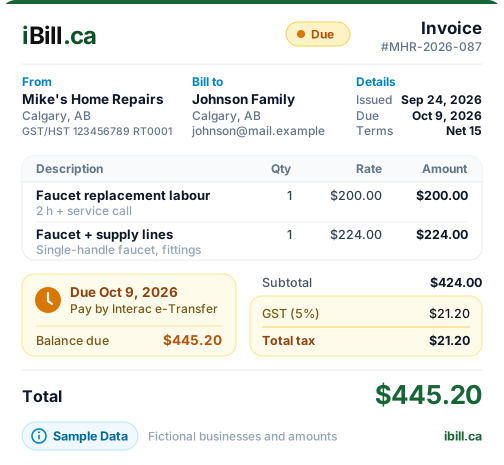
Sample Self-Employed Invoice

123 Main Street
Calgary, AB T2P 1A1
GST #: 123456789 RT0001

INVOICE

#MHR-2026-087
Date: Dec 18, 2026

Bill To:

Johnson Family
456 Oak Drive
Calgary, AB T2E 3B2

Payment Terms:

Due Date: Jan 2, 2026
Terms: Net 15
Payment: e-Transfer

Description Qty Rate Amount
Kitchen faucet replacement - labour 2 hrs $75/hr $150.00
Delta single-handle faucet (materials) 1 $189.00 $189.00
Supply lines and fittings 1 $35.00 $35.00
Service call fee 1 $50.00 $50.00

Subtotal: $424.00

GST (5%): $21.20

Total Due: $445.20 CAD

Common Self-Employment Deductions

Track these expenses to reduce your tax bill - keep all receipts!

Home Office

Rent, utilities, insurance

Vehicle

Gas, maintenance, insurance

Equipment

Computer, tools, software

Phone & Internet

Business portion

Advertising

Website, ads, marketing

Professional Fees

Accountant, legal, licenses

Insurance

Business, liability

Training

Courses, certifications

Travel

Business trips, meals

Bank Fees

Business account fees

Self-Employed Invoicing: Sole Proprietor Obligations, Home Office, Vehicle Expenses, and CRA Compliance

Being self-employed in Canada means you are both the business and the individual. Your invoices must reflect this dual role correctly, and your record-keeping must satisfy CRA requirements that salaried employees never encounter. From choosing the right business structure to tracking vehicle kilometres, every decision affects your tax obligations and your credibility with clients.

Sole Proprietor vs. Corporation: Invoicing Differences

As a sole proprietor, your legal name is your business name unless you register a trade name. Your invoices can use either your personal name or your registered business name, but your GST/HST registration (if applicable) is tied to you personally. Once your revenue exceeds $30,000 in four consecutive calendar quarters, you must register for a GST/HST account and charge tax on your invoices. If you incorporate, the corporation becomes a separate legal entity — invoices must use the corporate name, the corporation has its own GST/HST number, and payments go to the corporation, not to you personally. This distinction matters for your clients as well: paying a sole proprietor may trigger T4A reporting obligations on their end, while paying a corporation generally does not.

Home Office Expense Allocation

If you work from home, you can deduct a portion of your housing costs — rent or mortgage interest, utilities, property taxes, insurance, and maintenance — based on the percentage of your home used for business. CRA accepts two methods: a dedicated room as a percentage of total square footage, or a flat-rate method ($2 per day worked from home, up to $500 per year for the simplified method). While you do not itemize home office costs on your invoices, tracking these expenses alongside your invoicing revenue is essential for calculating your effective tax rate. A freelancer earning $80,000 with $6,000 in home office deductions reduces their taxable income significantly, which changes how much they should set aside for tax installments.

Separating Personal and Business Finances

CRA auditors look for clean separation between personal and business expenses. Using a single bank account for both is one of the most common red flags that triggers deeper scrutiny. Open a dedicated business bank account, even as a sole proprietor, and run all invoicing revenue and business expenses through it. If you use a personal asset (like a vehicle or phone) for business, document the business-use percentage and keep it consistent. CRA expects you to be able to justify every deduction with receipts and records. Co-mingling funds does not just create audit risk — it makes your own bookkeeping far more time-consuming at year-end.

Vehicle Expense Invoicing and CRA Rates

If you drive for business, you can either deduct actual vehicle expenses (fuel, insurance, maintenance, CCA depreciation) proportional to business use, or use CRA's per-kilometre rates. For 2024, the rates are $0.70 per kilometre for the first 5,000 km and $0.64 for each additional kilometre. If you invoice clients for travel — common for consultants, tradespeople, and service providers — show the distance, rate, and total as a line item. CRA requires a vehicle logbook recording the date, destination, purpose, and kilometres for every business trip. Without a logbook, your entire vehicle expense claim can be denied on audit. Digital mileage tracking through your invoicing software creates the documentation CRA expects.

Quarterly Tax Installments and Invoicing Revenue

If you expect to owe more than $3,000 in federal tax (or $1,800 in Quebec), CRA requires you to pay tax in quarterly installments. These are due March 15, June 15, September 15, and December 15. Your installment amounts are based on your invoicing revenue and deductions from the prior year. Tracking your invoicing revenue in real time — not just at year-end — lets you estimate whether your installments are on track or whether you need to adjust. Underpaying installments triggers interest charges from CRA, even if you pay the full balance at tax time. Connecting your invoicing records to your tax planning is not optional for self-employed Canadians; it is a requirement.

For detailed guidance on CRA record-keeping, see record keeping for Canadian taxes. Review year-end tax preparation for freelancers for filing tips, and explore business expense categories in Canada to ensure you are claiming every eligible deduction.

Self-Employed Invoice FAQs

How do I invoice as a self-employed person in Canada?
Create an invoice with your business name, address, GST/HST number (if registered), client details, invoice number/date, description of work, amounts, taxes, and payment terms. iBill.ca automates all of this with professional templates designed for self-employed Canadians.
Do I need a business number to send invoices?
No, you don't need a business number to invoice clients. You only need a GST/HST registration number if your annual revenue exceeds $30,000. Below this threshold, you can invoice without charging GST/HST. Learn more about CRA invoice requirements.
What's the difference between self-employed and incorporated?
Self-employed (sole proprietor) means you and your business are the same legal entity. You report business income on your personal tax return (T2125). Incorporation creates a separate legal entity with its own tax return. Most people start self-employed and incorporate later as their business grows.
Can I claim expenses if I work from home?
Yes! Self-employed Canadians can claim a portion of home expenses based on the percentage of your home used for business. This includes rent/mortgage interest, utilities, property tax, insurance, and internet. Use form T2125 to report these on your tax return.
How do I handle taxes as self-employed?
Self-employed Canadians pay income tax plus CPP contributions on net business income. Set aside 25-30% of earnings for taxes. If you're GST/HST registered, file returns quarterly or annually. Use our tax calculator to estimate amounts.
What's the difference between a sole proprietor and self-employed?
They're often used interchangeably. "Self-employed" describes your work status (you work for yourself), while "sole proprietor" describes your business structure (unincorporated, single-owner). All sole proprietors are self-employed, but self-employed can also include incorporated freelancers.
Do I need to charge GST if I make under $30,000?
No, if your annual revenue is under $30,000, you're considered a "small supplier" and don't need to charge or collect GST/HST. However, you can voluntarily register to claim Input Tax Credits on business expenses. Use our calculator to see if registration would benefit you.
Can I use my personal name on invoices?
Yes, as a sole proprietor, you can invoice using your personal legal name. Many self-employed Canadians also register a business name (Operating As / DBA) for a more professional appearance. Either is valid for CRA purposes as long as the invoice meets other requirements.
How long should I keep invoices for CRA?
The CRA requires you to keep all business records, including invoices, for at least 6 years from the end of the tax year they relate to. For example, 2024 invoices should be kept until at least 2030. Store digital copies - they're easier to organize and CRA accepts electronic records.
What payment terms should I use on invoices?
Common payment terms for self-employed invoices include: Net 15 (payment due in 15 days), Net 30 (30 days), or Due on Receipt. For new clients or larger projects, consider requiring a deposit upfront. Always clearly state the due date and accepted payment methods (e-Transfer, cheque, etc.).
Should I charge sales tax on services?
If you're GST/HST registered, yes - charge the appropriate rate based on where the service is performed. Most services are taxable, but some are zero-rated or exempt (basic groceries, medical services, child care). Check if your service category has special rules before invoicing.

Common Self-Employed Invoicing Mistakes to Avoid

Learn from others' mistakes and invoice like a professional from day one

Missing Invoice Numbers

Every invoice must have a unique, sequential number. This is a CRA requirement and helps track payments. Use a format like "INV-2026-001" for easy organization.

Vague Service Descriptions

Don't just write "consulting" - be specific: "Business strategy consultation - 3 hours - market analysis and growth planning." Detailed descriptions prevent payment disputes.

Wrong Tax Calculations

Tax rates vary by province. Ontario is 13% HST, BC is 12% (5% GST + 7% PST), Alberta is 5% GST only. Use iBill's auto-calculation to always get it right.

No Payment Due Date

Always include a clear due date. "Net 30" isn't as clear as "Due: January 15, 2026." Specific dates lead to faster payments.

Charging Tax Without Registration

If you're not GST/HST registered, you cannot charge GST/HST. Collecting tax without remitting it to CRA is a serious offence. Register first, then charge.

Not Keeping Copies

CRA requires 6 years of records. iBill automatically stores all your invoices securely in the cloud - no manual filing needed.

Self-Employment Invoicing Guide for Canadians

Self-Employed Invoice Template: What Makes It Different?

A self-employed invoice template is specifically designed for sole proprietors, independent workers, and one-person businesses in Canada. Unlike corporate invoices, self-employed invoices can use your personal legal name, don't require a GST/HST number if you're under the $30,000 threshold, and typically include details about the specific services you personally provided. The key is including all CRA-required elements while maintaining a professional appearance that builds client confidence.

Sole Proprietor Invoice Requirements in Canada

As a sole proprietor, your invoice must include: your name or registered business name, complete mailing address, a unique invoice number, the invoice date, a clear description of goods or services provided, the amount payable (in Canadian dollars), applicable taxes (if GST/HST registered), and payment terms. If you're registered for GST/HST, you must also show your 15-digit Business Number with the RT suffix. Missing any of these elements could cause issues during a CRA audit.

Self-Employment vs. Freelancing: Invoice Differences

While the terms are often used interchangeably, there are subtle differences in how you might structure invoices. Self-employed typically refers to anyone working for themselves, including tradespeople, consultants, and service providers. Freelancers usually work on project-based or contract work for multiple clients. Both use similar invoice formats, but freelancers often include project names or contract references, while self-employed tradespeople might include materials and labour breakdowns.

How to Set Your Self-Employment Invoice Rates

Pricing your services as self-employed can be challenging. Consider your hourly rate should cover: the time spent on the actual work, administrative time (invoicing, emails, meetings), business expenses (software, equipment, insurance), taxes (remember you pay both employer and employee CPP portions), and your desired profit. A common formula: calculate what you'd earn as an employee and multiply by 1.3-1.5 to account for self-employment costs.

Provincial Tax Considerations for Self-Employed Invoices

Canadian tax rates vary by province, affecting your invoice totals. Alberta, BC, Manitoba, and Saskatchewan use 5% GST only. Ontario uses 13% HST. Nova Scotia uses 14% HST (updated 2026). Other Atlantic provinces (NB, NL, PEI) use 15% HST. Quebec has a unique system: 5% GST plus 9.975% QST, both calculated separately on the subtotal. iBill automatically applies the correct tax rate based on where you do business, eliminating calculation errors.

Record-Keeping Requirements for Self-Employed Invoices

The CRA requires all business records be kept for at least 6 years from the end of the tax year they relate to. This includes all invoices issued, payment records, and supporting documentation. Digital records are fully acceptable - just ensure they're backed up and accessible. iBill stores all your invoices securely in the cloud, automatically organized by date and client, making CRA compliance effortless.

When to Invoice: Best Practices for Self-Employed

Timing matters for cash flow. For project work, invoice immediately upon completion or at agreed milestones. For ongoing services, establish a regular billing schedule (weekly, bi-weekly, or monthly). For large projects, consider progress billing with an upfront deposit (25-50%), mid-project payment, and final payment on completion. Always send invoices promptly - waiting too long can signal unprofessionalism and delay payment.

Getting Paid: Payment Methods for Self-Employed Canadians

The most common payment methods for self-employed Canadians include: Interac e-Transfer (instant, convenient, and widely used), cheque (still common for larger businesses), direct deposit/EFT (good for recurring clients), and credit card payments (convenient but typically charge 2.5-3% fees). Include clear payment instructions on every invoice with your preferred methods and any relevant details like email for e-Transfer.

Ready to Invoice Professionally?

Invoicing software for self-employed Canadians.

Create Account

• Unlimited Invoices • CRA-Ready