A complete step-by-step guide to getting your GST/HST number from the CRA
Registering for GST/HST is an important step for Canadian businesses. Whether you've exceeded the $30,000 threshold or want to register voluntarily, this guide walks you through everything you need to know about getting your GST/HST number and staying aligned with the Canada Revenue Agency (CRA).
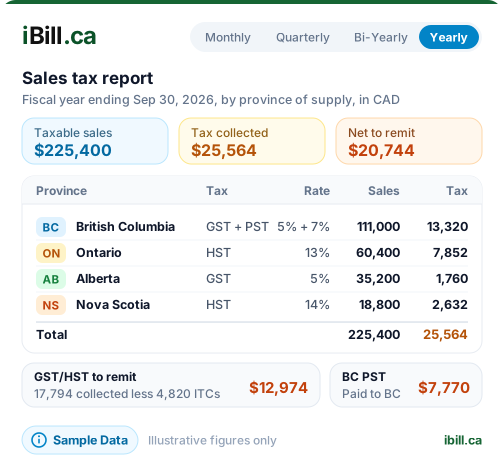
Sales tax report in iBill (sample data)
When Do You Need to Register for GST/HST?
You must register for a GST/HST account when your business becomes a "taxable supplier" in Canada. Here's when registration is mandatory:
The $30,000 Threshold Rule
You must register for GST/HST when your total worldwide taxable supplies exceed $30,000 in either:
A single calendar quarter, OR
Four consecutive calendar quarters combined
Once you exceed this threshold, you have 29 days to register with the CRA.
What Counts Toward the $30,000 Threshold?
The threshold includes all taxable supplies from your business activities worldwide, including:
Sales of goods and services in Canada
Zero-rated supplies (exports, basic groceries)
Sales made through partnerships or associated businesses
What Doesn't Count?
Exempt supplies (residential rent, most health services, childcare)
Sales of goodwill when selling a business
Financial services (for the most part)
Benefits of Voluntary GST/HST Registration
Even if you're under the $30,000 threshold, you may want to register voluntarily. Here's why many small businesses choose to register early:
Advantages of Early Registration
Input Tax Credits (ITCs): Recover GST/HST paid on business expenses
Professional Credibility: Having a GST/HST number signals an established business
B2B Requirements: Some businesses only work with GST-registered suppliers
Growth Preparation: Be ready before you hit the threshold
Startup Expense Recovery: Claim ITCs on equipment, inventory, and startup costs
Consider This Before Registering Voluntarily
Once registered, you must charge GST/HST to all customers (even if under $30,000), file regular returns, and maintain proper records. If most of your customers are consumers (not businesses), adding 5-15% tax to your prices may affect competitiveness.
What You Need Before Registering
Gather this information before starting your registration:
Registration Requirements Checklist
Social Insurance Number (SIN) - for sole proprietors
Business incorporation number - for corporations
Legal business name and operating/trade name
Business address and mailing address
Type of business structure (sole proprietor, partnership, corporation)
Fiscal year end date
Estimated annual revenue
Description of business activities
Date business started or will start making taxable supplies
How to Register for GST/HST
There are three ways to register for a GST/HST account with the CRA:
Option 1: Register Online (Recommended)
The fastest and most convenient method is through CRA's Business Registration Online (BRO):
1 Go to CRA Business Registration Online
Visit canada.ca/business-registration-online and select "Register for a business number and CRA accounts."
2 Verify Your Identity
Enter your SIN (sole proprietors) or corporation number. Answer security questions to verify your identity.
3 Complete Business Information
Provide your business details: legal name, address, type of business, and description of activities.
4 Select GST/HST Account
Choose to register for a GST/HST program account. Select your fiscal year end and reporting period.
5 Receive Your Business Number
You'll receive your 9-digit Business Number (BN) and GST/HST account number immediately. Format: 123456789RT0001
Already Registered? Start Creating Ready Invoices
iBill automatically adds your GST/HST number to every invoice and calculates tax for supported Canadian provinces.
Call the CRA business enquiries line at 1-800-959-5525. Have all your business information ready. Hours: Monday to Friday, 9am to 5pm local time.
Option 3: Register by Mail
Complete form RC1 - Request for a Business Number and mail it to your tax services office. This method takes 2-4 weeks for processing.
Understanding Your GST/HST Number
After registration, you'll receive a Business Number (BN) that looks like this:
GST/HST Number Format: 123456789RT0001
123456789 - Your unique 9-digit Business Number
RT - Program identifier for GST/HST
0001 - Account number (0001 for your first GST/HST account)
This number must appear on all invoices where you charge GST/HST. Clients need it to claim Input Tax Credits.
What Happens After Registration
Once registered, you have several ongoing responsibilities:
1. Charge GST/HST on Taxable Supplies
You must charge the appropriate rate based on where the supply is made:
Province
Tax Type
Rate
Alberta, Territories
GST only
5%
British Columbia
GST + PST
5% + 7%
Ontario
HST
13%
Nova Scotia
HST
14%
Quebec
GST + QST
5% + 9.975%
2. File GST/HST Returns
Your filing frequency depends on your annual taxable supplies:
Annual Revenue
Filing Frequency
Due Date
Under $1.5 million
Annual
3 months after year-end
$1.5M - $6 million
Quarterly
1 month after quarter-end
Over $6 million
Monthly
1 month after month-end
3. Claim Input Tax Credits (ITCs)
Recover the GST/HST you paid on business expenses by claiming ITCs on your return. Keep all receipts and invoices for at least 6 years.
4. Keep Proper Records
The CRA requires you to maintain records of all purchases and sales, including invoices, receipts, and contracts.
Common GST/HST Registration Mistakes to Avoid
Mistakes That Can Cost You
Registering too late: You have only 29 days after exceeding $30,000 - missing this can result in penalties
Not charging tax immediately: Once registered, you must charge GST/HST on all taxable supplies from day one
Wrong tax rates: Make sure you're charging the correct rate based on the customer's location
Missing filing deadlines: Late filing results in penalties and interest charges
Poor record keeping: Without proper documentation, you can't claim ITCs
Forgetting to include GST/HST number on invoices: Required for clients to claim their own ITCs
Quick Calculation Method (Optional)
When calculating your threshold, include all taxable and zero-rated sales but exclude exempt supplies. If you're unsure whether you've reached $30,000, track your monthly sales carefully.
Example Threshold Calculation
A freelance web developer earned:
Q1 (Jan-Mar): $8,500
Q2 (Apr-Jun): $9,200
Q3 (Jul-Sep): $7,800
Q4 (Oct-Dec): $6,100
Total: $31,600 - Must register within 29 days of exceeding $30,000 (which occurred during Q4).
GST/HST Registration: Step-by-Step Process, Voluntary Benefits, and Compliance Pitfalls
Registering for GST/HST is a critical milestone for any growing Canadian business. Whether you are required to register because you have crossed the $30,000 threshold or you are choosing to register voluntarily, understanding the registration process, filing options, and consequences of non-compliance will save you time, money, and potential penalties. This guide walks through every aspect of the registration journey.
Step-by-Step: Registering for a Business Number With CRA
You can register for a GST/HST account in three ways. The fastest is online through CRA Business Registration Online (BRO), accessible via CRA My Business Account or the Registration service for businesses. You will need your Social Insurance Number (SIN), legal business name, business address, type of business activity, fiscal year-end date, and estimated annual revenue. The online process takes about 15 to 20 minutes, and you receive your Business Number (BN) with an RT program account suffix immediately upon completion. Alternatively, you can register by phone by calling CRA at 1-800-959-5525 (Monday to Friday, 9 a.m. to 6 p.m. local time). A third option is to mail Form RC1, Request for a Business Number, to your regional tax services office, though this takes several weeks. For most businesses, online registration is the recommended approach. Once registered, your GST/HST number must appear on all invoices. Learn the required fields in our GST invoice calculation guide.
Voluntary Registration: Why Register Before You Must
If your business earns less than $30,000 per year, you are not required to register, but doing so can offer significant advantages. The primary benefit is the ability to claim Input Tax Credits (ITCs) to recover the GST/HST you pay on business purchases such as equipment, software, office supplies, and professional services. Without registration, you absorb those taxes as a cost. Voluntary registration also lends credibility: some larger clients and government agencies prefer or require that their vendors be GST/HST registered. Additionally, registering early means you are prepared when your revenue grows past the threshold, avoiding the scramble of retroactive registration. The only downside is the administrative obligation to file GST/HST returns and remit collected tax, but for most small businesses this is straightforward, especially with automated invoicing tools. For details on what triggers mandatory registration, see our guide on when to charge GST/HST.
Choosing Your Reporting Period
When you register, CRA assigns a reporting frequency based on your annual taxable supplies. Businesses with revenue under $1.5 million file annually, which means one return per year with the option to pay in quarterly installments. Revenue between $1.5 million and $6 million requires quarterly filing, with returns due one month after each quarter ends. Revenue exceeding $6 million requires monthly filing, with returns due one month after each reporting period. You can voluntarily elect to file more frequently than required. Many small businesses choose quarterly filing even when eligible for annual, because it keeps cash flow more predictable and avoids a large lump-sum payment at year-end. You can change your filing frequency by contacting CRA, though some changes take effect only at the start of the next fiscal year.
The Quick Method of Accounting
The Quick Method is a simplified way to calculate your GST/HST remittance, available to businesses with annual taxable supplies (including GST/HST) of $400,000 or less. Instead of tracking ITCs on every purchase, you remit a fixed percentage of your GST/HST-included revenue. The remittance rate varies by province and business type, typically ranging from 1.8% to 8.8% of revenue. For example, a service-based business in Ontario using the Quick Method might remit 8.8% of HST-included sales rather than calculating actual ITCs. On the first $30,000 of revenue each year, the rate is reduced by 1%. The Quick Method often results in a small net benefit for businesses with few ITC-eligible expenses. You elect the Quick Method by filing Form GST74 with CRA. Note that you cannot claim ITCs on most purchases when using the Quick Method, except on capital property purchases over $30,000.
What Happens If You Should Have Registered But Did Not
If CRA determines that you exceeded the $30,000 threshold and failed to register within the required 29-day window, you face retroactive liability. CRA can assess you for all GST/HST that should have been collected from the date you were required to register, plus interest and penalties. The penalty for late registration is typically 1% of the net tax owing for each month you were late, up to 12 months. You may also lose the ability to claim ITCs for the period you were unregistered, since only registered businesses can claim them. If you realize you should have registered earlier, CRA offers a Voluntary Disclosures Program (VDP) that can reduce or eliminate penalties and prosecution in exchange for coming forward proactively. To be eligible, the disclosure must be voluntary (not triggered by a CRA audit), complete, and involve a penalty. Filing through the VDP is significantly more favourable than waiting for CRA to discover the oversight. Track your revenue thresholds proactively using our CRA tax reporting tools.
Track Your GST/HST With iBill.ca
iBill.ca automatically calculates GST/HST on your invoices and generates tax reports for easy filing. For Canadian businesses.
You must register for GST/HST when your business earns more than $30,000 in worldwide taxable supplies in a single calendar quarter or over four consecutive calendar quarters. Once you exceed this threshold, you have 29 days to register with the CRA.
How do I register for a GST/HST number online?
You can register for GST/HST online through the CRA Business Registration Online service. You'll need your Social Insurance Number (SIN), business information, and expected revenue. The process takes about 15-20 minutes and you'll receive your Business Number (BN) immediately.
What are the benefits of voluntary GST/HST registration?
Voluntary registration allows you to claim Input Tax Credits (ITCs) to recover GST/HST paid on business expenses, makes your business appear more established and credible, and prepares you for growth before hitting the $30,000 threshold.
How often do I need to file GST/HST returns?
Your filing frequency depends on your annual taxable supplies: under $1.5 million files annually, $1.5 million to $6 million files quarterly, and over $6 million files monthly. New registrants typically start with annual filing.
Registered for GST/HST? Create your first ready invoice in minutes.