
Ontario invoice software with HST and accounting built in
Ontario: 13% HST on taxable sales, calculated on every invoice for you. Send the invoice, record the payment, track expenses and run your sales tax report from the same account.
Free · No credit card · All features included
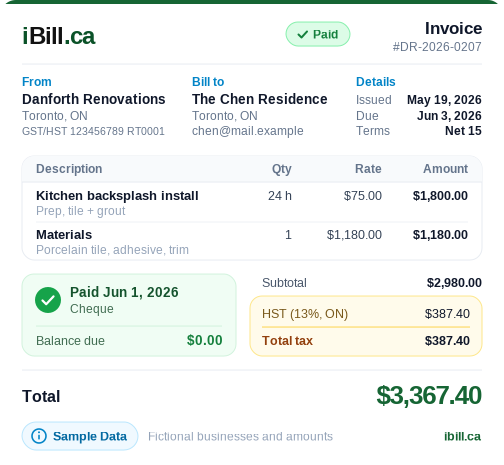
Ontario sales tax at a glance
Ontario uses the harmonized sales tax: the federal and provincial parts are a single tax, charged on one line and reported on one return to the Canada Revenue Agency.
| Tax | Rate | Who has to register | Reported to |
|---|---|---|---|
| HST | 13% | Businesses whose taxable sales pass $30,000 in a single calendar quarter or over four consecutive calendar quarters. Below that, registering is optional. | Canada Revenue Agency |
Rates checked: October 2026. There is no separate provincial sales tax in Ontario.
Invoicing clients in other provinces
An Ontario business doesn’t charge 13% HST to everyone. iBill uses your client’s province, so the tax on the invoice changes with the client.
| Your client is in | What iBill adds | When the provincial part applies |
|---|---|---|
| Client in British Columbia | 5% GST + 7% PST | PST only on taxable goods, software and listed services. Turn on PST Exempt when it doesn’t apply. |
| Client in Alberta | 5% GST | No provincial sales tax. |
| Client in Quebec | 5% GST + 9.975% QST | Check whether you have to collect QST before charging it. |
| Client in Nova Scotia | 14% HST | One harmonized tax on taxable goods and services. |
For most services, GST/HST follows the province of your client’s home or business address. For work on a building or land, the tax belongs to the province where the property is (Excise Tax Act, Schedule IX, Part IV). If the site isn’t in your client’s province, check the tax before you send.
Invoicing tips for Ontario businesses
Put your HST registration number on every invoice once you’re registered. Commercial clients need it to claim their input tax credits, and many accounts payable teams won’t pay an invoice without it.
If you also work for clients in other provinces, set each client’s province carefully when you add them. That one field decides the tax on every invoice you send them, so a client in Gatineau and a client in Ottawa get different tax even though they’re minutes apart.
Accounting for Ontario businesses
Beyond HST, these are the Ontario rules small businesses ask about most. Each is checked against the official source.
Employer health tax
If you have employees, Ontario’s employer health tax is charged on payroll above an exemption that is currently $1 million a year. Most private employers can claim it as long as their Ontario payroll, including any associated employers, is under $5 million. Below the exemption, an eligible employer pays nothing.
iBill doesn’t run payroll or calculate EHT; your payroll provider or accountant handles it.
Input tax credits
Once you’re registered, the HST you pay on business purchases can generally be claimed back as input tax credits on your return. Keep the receipts: iBill stores a photo of each receipt with the expense, so the tax you paid sits next to the cost.
Record keeping
Keeping your business records for CRA, generally for six years, is your responsibility. iBill keeps your invoices, payments and expenses together, and you can export them whenever your accountant asks.
Construction contracts
Contractors working on improvements to Ontario property, such as installations, additions and capital repairs, are covered by the Construction Act. The owner must pay a proper invoice within 28 days of receiving it unless they send a notice of non-payment within 14 days, and a 10% holdback usually applies. Write the contract or purchase order number and the work period in the invoice notes; iBill doesn’t track holdbacks.
Workplace insurance
If you hire workers, check whether your business has to register with the Workplace Safety and Insurance Board. It depends on your industry and how you’re set up, and the WSIB decides it, not your invoicing software.
Sources: Ontario employer health tax (updated September 18, 2026); New Harmonized Value-added Tax System Regulations, No. 2, s. 13; Ontario Construction Act, ss. 6.1, 6.4 and 22; Excise Tax Act, s. 148; Excise Tax Act, s. 169 (input tax credits); WSIB. Checked October 19, 2026. General information, not tax or legal advice.
Pages for Ontario cities
How iBill handles Ontario tax
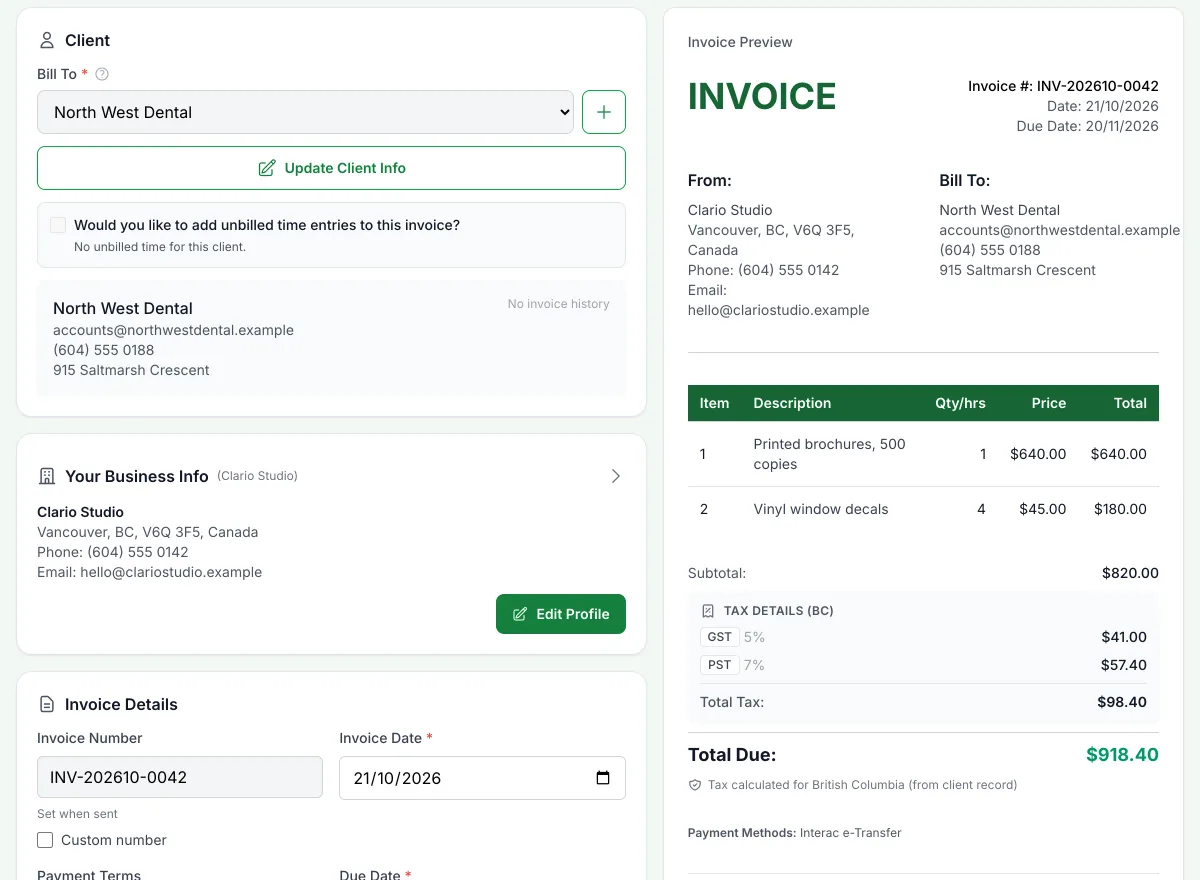
HST on every invoice
Choose an Ontario client and iBill adds 13% HST. Choose a client in another province and the invoice switches to that province’s tax, with nothing to look up.
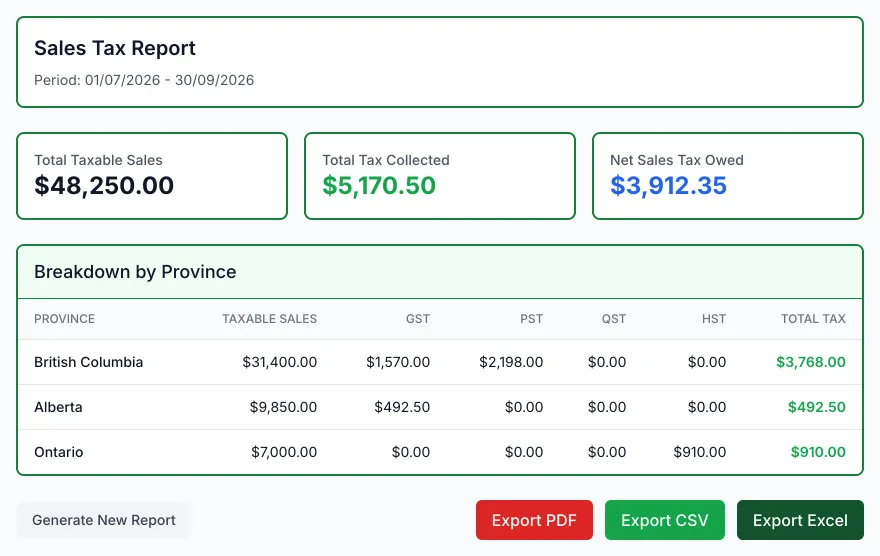
A report for your HST return
The sales tax report shows the tax you charged in any period, so your return starts from numbers you can trust instead of a spreadsheet.
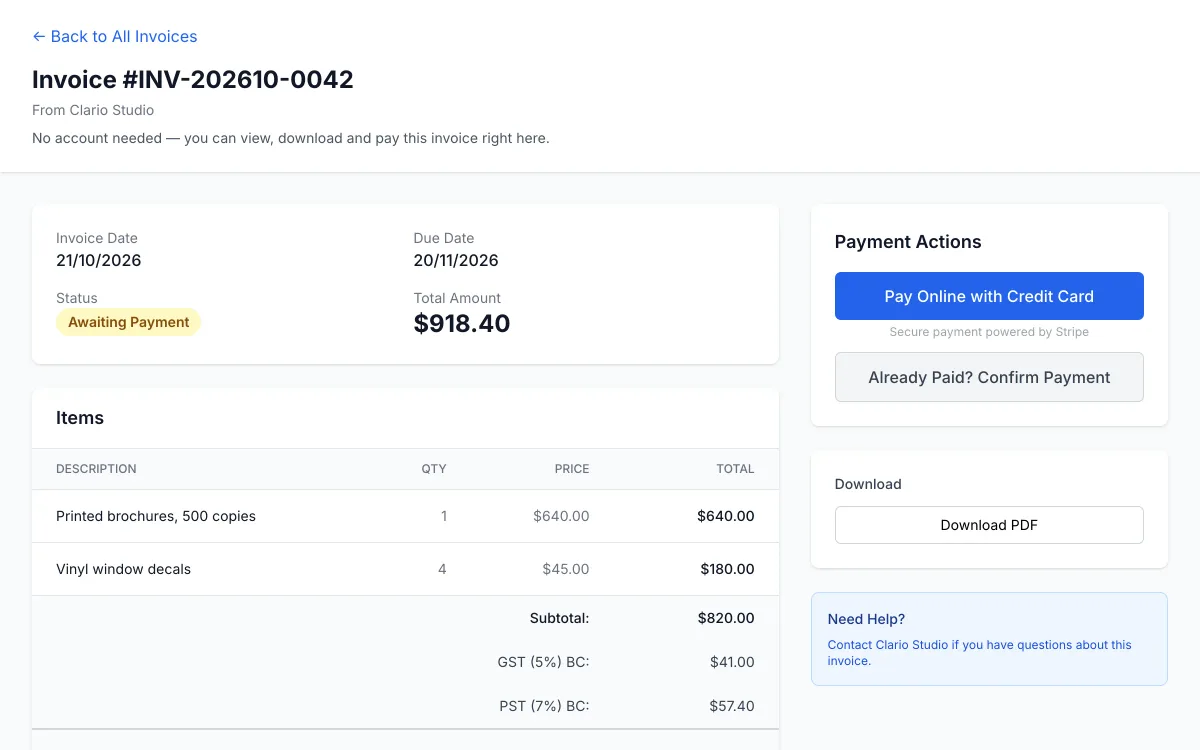
A page your client can pay from
Each invoice email links to a page where your client sees the invoice and, if you connect Stripe, can pay by card. Record the payment when it arrives.
Ontario invoicing questions
Do I charge 13% HST to clients outside Ontario?
When do I have to register for HST?
Does iBill calculate the Ontario employer health tax?
How do I make a proper invoice for an Ontario construction client?
Can I show my HST number on invoices?
Ontario businesses: the right HST on every invoice
Invoices, payments, expenses and your sales tax report in one place.
Start freeFree · No credit card · All features included · Join 1,200+ Canadian Businesses