
Tax Compliance Guide for Canadian Small Businesses
Stay aligned with CRA requirements — record-keeping, GST/HST filing, invoice rules, and audit defense. Compliance tools built for Canadian businesses.
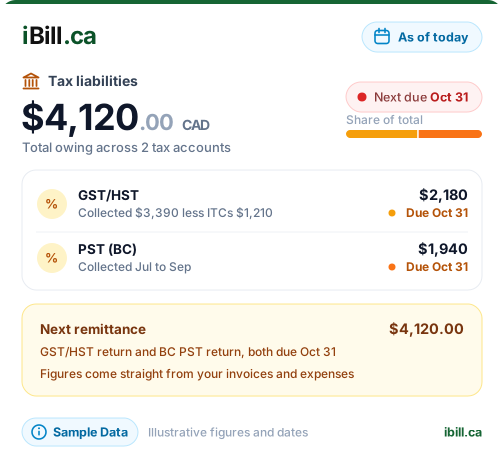
Key Tax Compliance Areas for Canadian Businesses
Everything you need to stay on the right side of the CRA — automated record-keeping, ready invoicing, tax filing data, and a complete audit trail.
CRA Record-Keeping Requirements (ITA s.230)
The Income Tax Act, section 230, requires every Canadian business to maintain adequate books and records. The CRA can request these records at any time, and failure to maintain them can result in penalties or estimated assessments.
What Records You Must Keep
- Source documents — sales invoices, purchase receipts, bank statements, contracts, cancelled cheques, and deposit slips. These are the foundation of your records and must be original or certified copies.
- General ledger — a chronological record of all financial transactions with debits and credits that balance. iBill maintains a full double-entry general ledger with numbered journal entries that post automatically when you record payments.
- Accounts receivable and payable — records of who owes you money and who you owe. iBill tracks both through its AR aging and accounts payable modules.
- Payroll records — T4s, RL-1s, pay stubs, and remittance records if you have employees.
6-Year Retention Rule
All records must be retained for at least 6 years from the end of the last tax year they relate to. If you filed your 2025 corporate return, you must keep those records until at least the end of 2031. iBill's append-only audit trail preserves every transaction with SHA-256 document hashing for tamper detection — records cannot be altered or deleted after the fact.
Digital Records
The CRA accepts electronic records as long as they are accessible, readable, and can be provided on request. Digital records must be stored in a format that can be related back to the original source document. iBill stores all invoices, journal entries, and audit events digitally with full traceability from any transaction back to its source.
GST/HST Registration & Filing Obligations
If your business makes taxable supplies in Canada, you need to understand when and how to register for GST/HST, how to file returns, and what happens if you fall behind.
Small Supplier Threshold
You are considered a small supplier and are not required to register for GST/HST if your worldwide taxable revenue is $30,000 or less in a single calendar quarter and over four consecutive calendar quarters. Once you exceed this threshold, you must register within 29 days. Voluntary registration is allowed at any time and lets you claim input tax credits (ITCs) on business purchases.
Filing Frequency
- Annual filing — revenue under $1.5 million. Return due 3 months after fiscal year-end.
- Quarterly filing — revenue between $1.5 million and $6 million. Returns due 1 month after each quarter.
- Monthly filing — revenue over $6 million. Returns due 1 month after each reporting period.
iBill's tax reports calculate your GST/HST liability by filing period — tax collected minus input tax credits — so you always know your net tax obligation before the deadline.
Provincial Sales Tax
Tax obligations vary by province. HST provinces (Ontario, New Brunswick, Newfoundland and Labrador, Nova Scotia, Prince Edward Island) combine federal and provincial tax into a single rate. Quebec charges QST separately from GST. British Columbia and Saskatchewan charge PST, and Manitoba charges RST (its retail sales tax), separately from GST. Alberta and the territories charge GST only. iBill's tax calculator handles supported Canadian provinces and territories automatically.
Penalties for Late Filing
Late GST/HST filing incurs an immediate penalty of 1% of the amount owing, plus 0.25% for each additional month late, up to 12 months (maximum 4%). Repeated late filers face double penalties. Interest compounds daily at the prescribed rate. Filing on time — even if you cannot pay in full — avoids the filing penalty entirely.
Invoice Compliance: What the CRA Requires
The Excise Tax Act (ETA) Section 3 sets out tiered requirements for invoices based on the transaction amount. Meeting these requirements is essential for your clients to claim input tax credits and for your own audit readiness.
Tiered Invoice Requirements
- Under $100 — supplier name, date, and total amount payable.
- $100 to under $500 — all of the above, plus: supplier's GST/HST registration number, and the tax amount or a statement that tax is included with the total tax rate.
- $500 or more — all of the above, plus: buyer's name or trading name, payment terms, and a description of each supply sufficient to identify it.
iBill's CRA-ready invoice templates include all required fields automatically and validate against these thresholds when you issue an invoice.
Sequential Invoice Numbering
While not explicitly mandated by law, the CRA expects invoices to be sequentially numbered with no unexplained gaps. Gaps in invoice numbers are a common audit trigger. iBill uses an automatic numbering system (INV-YYYYMM-NNN format) that assigns numbers only when invoices are issued — never on draft creation — to prevent gaps from abandoned drafts.
Required Fields Checklist
- Legal business name and operating name (if different)
- Business address
- GST/HST registration number
- Invoice number (sequential)
- Invoice date
- Client name and address
- Description of goods or services
- Amount of each tax component (GST, HST, PST, or QST)
- Total amount payable
- Payment terms
Building an Audit-Ready Paper Trail
An audit-ready business does not scramble when the CRA sends a review letter. Every transaction is documented, every change is logged, and every correction follows a verifiable chain. Here is what that looks like in practice.
Append-Only Audit Logs
iBill maintains an append-only audit trail where every financial event — invoice creation, payment recording, voiding, corrections — is logged with a timestamp, user ID, and action description. Entries cannot be edited or deleted after the fact. Each entry includes a SHA-256 document hash for tamper detection.
Void Documentation
When an invoice needs to be voided, iBill requires a mandatory reason and preserves the complete record. The original invoice remains in the system with a "voided" status, all GL entries are reversed automatically, and the void reason is embedded in the reversing journal entry. The voided invoice register provides a complete list of all voided invoices with dates, amounts, and reasons.
Correction Chains
If an issued invoice contains an error, iBill creates a documented correction chain rather than modifying the original. For unpaid invoices: void the original and reissue a corrected version with a link back to the voided invoice. For paid invoices: issue a credit note for the difference, then issue a corrected invoice. Both paths maintain full traceability from original to correction.
Credit Notes
Credit notes (credit memos) follow ETA s.232 requirements with full tax breakdown — GST/HST, PST, and QST amounts are calculated and documented separately. Each credit note links to the original invoice and includes the reason for the adjustment. The credit note register provides an audit-ready summary.
Get Audit-Ready
CRA-ready invoicing, automatic audit trail, 9 compliance reports, and GST/HST filing data.
Create AccountYear-End Tax Checklist for Small Businesses
A well-organized year-end close makes tax filing straightforward and reduces the risk of errors. Here is what you need to have ready before filing.
Financial Statements
- Income statement — total revenue (cash received) and expenses for the fiscal year. iBill generates this from your GL with a single click.
- Balance sheet — your financial position as of year-end: assets, liabilities, and equity. Confirms that your books balance (A = L + E).
- Trial balance — total debits must equal total credits. If they do not, there is an error in your books that needs to be found before filing.
- Cash flow statement — tracks cash movement through operating, investing, and financing activities.
Tax Summaries
- GST/HST summary — total tax collected, input tax credits (ITCs) claimed, and net tax remitted or owing for each filing period. iBill's tax reports calculate this automatically.
- PST/QST summary — for businesses in BC, Saskatchewan, Manitoba, or Quebec, a separate summary of provincial tax collected and remitted.
Capital Cost Allowance (CCA)
Business assets like vehicles, computers, and equipment are depreciated over time using CRA-prescribed rates. iBill's CCA module calculates depreciation by CRA class with half-year rule support, and the CCA calculator lets you model depreciation scenarios before purchasing assets.
Expense Categories
Expenses need to be categorized according to CRA-standard categories for T2125 (sole proprietor/partnership) or T2 (corporate) returns: advertising, meals and entertainment, motor vehicle, office, professional fees, rent, salaries, travel, and more. iBill categorizes expenses as you log them and provides a year-end breakdown by category.
Period-End Reconciliation
Before closing a fiscal period, iBill runs 8 automated checks: trial balance validation (debits = credits), balance sheet equation (A = L + E), AR reconciliation, tax sub-ledger vs GL reconciliation, revenue reconciliation, orphaned journal entry detection, invoice sequence gap analysis, and pending approval review. These checks catch discrepancies before you file.
What Happens During a CRA Audit
A CRA audit (or "review") is an examination of your books, records, and returns to verify that you have reported correctly and paid the right amount of tax. Understanding the process removes the uncertainty.
Types of CRA Reviews
- Desk audit (correspondence) — the CRA sends a letter requesting specific documents or clarification. Most common for small businesses. You mail or upload the requested records.
- Office audit — you bring your records to the CRA office for review. Typical for GST/HST-specific reviews.
- Field audit — a CRA auditor visits your place of business. Usually reserved for complex cases or larger businesses.
What Auditors Check
- Whether reported revenue matches bank deposits and invoices
- Whether claimed expenses have supporting documentation (receipts, invoices)
- Whether GST/HST was charged and remitted correctly
- Whether input tax credits (ITCs) are supported by valid supplier invoices
- Whether invoice numbers are sequential with no unexplained gaps
- Whether books and records are adequate under ITA s.230
Common Audit Triggers
- Revenue significantly below industry averages for your sector
- Large fluctuations in reported income year-over-year
- Consistently reporting losses while maintaining a lifestyle
- High ratio of cash transactions
- Late filing or non-filing of returns
- Inconsistencies between GST/HST returns and income tax returns
How to Prepare
The best audit defense is organized records maintained throughout the year — not assembled after receiving a notice. iBill provides 9 compliance reports designed specifically for audit defense: voided invoice register, credit note register, invoice sequence analysis with gap detection, AR reconciliation, tax liability reconciliation, amendment tracker, correction chain documentation, user action summary, and full audit trail export in CSV, JSON, or XML format.
Tax Compliance Tools — Built In
Every tool a Canadian small business needs to stay ready and audit-ready
Append-Only Audit Trail
Every financial event is logged with timestamps, user IDs, and SHA-256 document hashing. Records cannot be altered or deleted — meeting CRA requirements for record integrity under ITA s.230.
9 CRA Compliance Reports
Voided invoice register, credit note register, invoice sequence analysis, AR reconciliation, tax reconciliation, amendment tracker, correction chains, user action summary, and full audit trail export.
GST/HST Tax Reports
Tax collected vs input tax credits by filing period. Supports supported Canadian provinces and territories. Reported on the earlier of the invoice date or the payment date (Excise Tax Act s.168).
Sequential Invoice Numbering
Automatic INV-YYYYMM-NNN format with monthly reset. Numbers assigned only on issuance (never on draft creation) to prevent gaps. Invoice sequence analysis detects and documents any gaps.
CCA Depreciation Calculator
Calculate capital cost allowance by CRA class with half-year rule and AIIP support. Class 10.1 vehicle caps, Class 54 zero-emission vehicle caps, straight-line Class 14 — CRA rates built in.
Period-End Reconciliation
8 automated checks before closing a fiscal period: trial balance, balance sheet equation, AR reconciliation, tax sub-ledger vs GL, revenue reconciliation, orphaned JEs, invoice sequence gaps, and pending approvals.
Canadian Tax Compliance FAQs
Ready to make tax compliance effortless?
Create AccountTax Compliance — Automated
CRA-ready invoicing, audit trail, compliance reports, and tax filing data. Get started in minutes, no time limit.
Create AccountUnlimited Invoices • CRA Audit-Ready