iBill.ca
Get Started
Atlantic Canada Invoice Software

Invoice Software for Atlantic Canada

One platform for all four Atlantic provinces. Automatic HST calculation for Nova Scotia, New Brunswick, Newfoundland & Labrador, and Prince Edward Island.

Nova Scotia
14%
HST (5+9%)
New Brunswick
15%
HST (5+10%)
Newfoundland
15%
HST (5+10%)
PEI
15%
HST (5+10%)
All Rates Auto-Calculated

Atlantic Canada HST Rates Compared

All four Atlantic provinces use the Harmonized Sales Tax, but the rates are not identical. Here is a side-by-side breakdown for 2026.

Province Federal GST Provincial Portion Total HST $1,000 Invoice Tax
Nova Scotia 5% 9% 14% $140.00
New Brunswick 5% 10% 15% $150.00
Newfoundland & Labrador 5% 10% 15% $150.00
Prince Edward Island 5% 10% 15% $150.00
Ontario 5% 8% 13% $130.00
Alberta 5% 0% 5% $50.00
British Columbia 5% 7% PST 12% $120.00

Nova Scotia reduced its HST from 15% to 14% effective April 1, 2025. The other three Atlantic provinces remain at 15%.

Nova Scotia

14% HST

Tax Structure

Nova Scotia's HST dropped from 15% to 14% effective April 1, 2025, reducing the provincial component from 10% to 9% while the federal 5% GST remains unchanged. This is the first NS rate change since 2010, and it means Nova Scotia businesses now pay $10 less in tax per $1,000 invoiced compared to their New Brunswick, Newfoundland, and PEI counterparts.

For businesses that invoice clients across multiple Atlantic provinces, the rate difference matters. Under CRA place-of-supply rules, if a Halifax consultancy provides services to a Moncton client, the invoice should reflect New Brunswick's 15% HST, not Nova Scotia's 14%. iBill.ca handles this automatically based on the client's province setting.

Key Industries

Nova Scotia's economy is anchored by the ocean. The fishing industry along the South Shore and Cape Breton coast drives seasonal invoicing surges, with lobster harvesters, scallop draggers, and groundfish operations all generating high invoice volumes during harvest season from May through October. A lobster wholesaler in Lunenburg might process hundreds of invoices in a six-week window, each priced by species grade and daily shore price.

Halifax's defence and shipbuilding sector, centred on the Halifax Shipyard, supports a deep contractor supply chain where progress billing tied to project milestones is the norm. The city's growing ocean technology cluster generates consulting and R&D invoices that often span international clients, requiring proper zero-rating documentation for HST purposes.

Nova Scotia's film tax credit has attracted significant production activity, creating invoicing needs for crew members, equipment rental houses, and location services, all requiring clear HST documentation for production accountants claiming ITCs.

Cities and Communities

Halifax Dartmouth Sydney Truro New Glasgow Glace Bay Kentville Amherst Bridgewater Yarmouth Lunenburg Wolfville

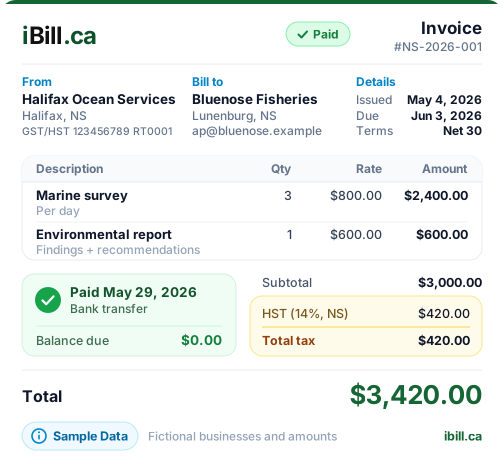
Invoice #NS-2026-001

Halifax Ocean Services Ltd.

Marine Survey (3 days) $2,400.00
Environmental Report $600.00
Subtotal $3,000.00
HST (14%) $420.00
Total Due $3,420.00

Nova Scotia's 14% HST saves $30 on this invoice vs. the 15% rate in the other Atlantic provinces.

New Brunswick

15% HST

Tax Structure

New Brunswick charges 15% HST, combining the 5% federal GST with a 10% provincial component into a single harmonized tax. Unlike dual-tax provinces where GST and PST are filed separately, New Brunswick businesses file one HST return with the CRA. The 15% rate has been stable for years, making tax calculation straightforward for businesses operating within the province.

New Brunswick provides point-of-sale rebates on children's clothing, footwear, diapers, and feminine hygiene products, effectively zero-rating the provincial portion of HST on these items. Businesses selling these goods need invoicing that correctly reflects the rebated amount.

Key Industries

New Brunswick is Canada's only officially bilingual province, and this shapes invoicing practices directly. Businesses in the francophone north and northeast, around Bathurst, Edmundston, Campbellton, and the Acadian Peninsula, frequently issue invoices in French. Government contracts and institutional clients often require documentation in both official languages. While CRA accepts invoices in either language, serving francophone clients in their preferred language is essential for these communities.

Forestry remains a cornerstone of the New Brunswick economy. Logging contractors bill by the cord, cubic metre, or tonne, with softwood sawlogs, hardwood pulpwood, and biomass chips each priced differently. Silviculture contractors performing tree planting and brush clearing invoice on a per-hectare or per-tree basis, with rates varying by terrain. The spring breakup halts most operations from March through May, creating pronounced seasonal billing gaps that make invoice tracking critical for cash flow management.

The Irving refinery in Saint John, one of the largest in Canada, generates a deep network of contractor and subcontractor invoicing for specialized trades including pipefitting, welding, insulation, and instrumentation. Moncton has emerged as an Atlantic tech hub, with software companies and cybersecurity firms generating retainer-based and milestone billing that often spans multiple provinces.

Cities and Communities

Fredericton Moncton Saint John Dieppe Miramichi Edmundston Bathurst Campbellton Riverview Quispamsis Oromocto Woodstock

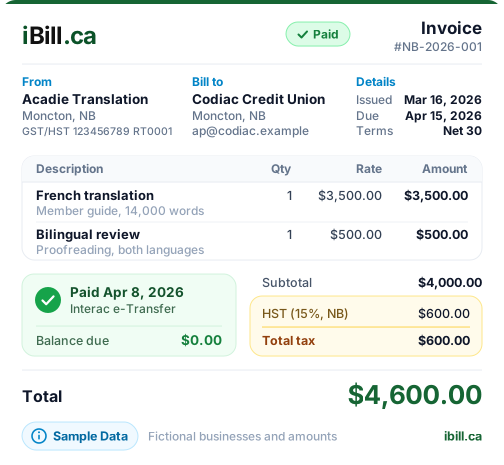
Invoice #NB-2026-001

Moncton Web Solutions Inc.

Website Development $3,500.00
Bilingual Content Setup $500.00
Subtotal $4,000.00
HST (15%) $600.00
Total Due $4,600.00

NB's bilingual workforce serves clients across both language communities.

Newfoundland & Labrador

15% HST

Tax Structure

Newfoundland and Labrador charges 15% HST, combining the 5% federal GST with a 10% provincial component. The province adopted HST in 1997 and has maintained the 15% rate consistently. Like all HST provinces, NL businesses file a single harmonized return with CRA rather than separate federal and provincial filings.

Newfoundland and Labrador provides a point-of-sale rebate on children's clothing and footwear (items priced under $100), removing the provincial HST component at the cash register. Businesses selling children's apparel need invoicing systems that can properly reflect this rebate.

Key Industries

Newfoundland and Labrador's economy is defined by two pillars: offshore petroleum and the fishing industry. The offshore oil sector, centred on production platforms like Hibernia, Terra Nova, and White Rose in the Jeanne d'Arc Basin, generates a massive contractor ecosystem. Service companies in St. John's provide everything from subsea engineering and marine transportation to catering and helicopter support, each with specialized invoicing that includes project codes, purchase order references, and safety compliance documentation. A single offshore platform turnaround can generate thousands of contractor invoices over a few weeks.

The cod moratorium of 1992 reshaped Newfoundland's fishing industry, but shellfish, particularly snow crab, shrimp, and turbot, have created a thriving export-focused fishery. Fish processing plants in communities like Fortune, Harbour Breton, and Bonavistan invoice buyers across North America, Asia, and Europe, requiring proper zero-rating for export invoices. Inshore harvesters selling to buyers invoice based on species, size grade, and daily market price, creating variable-rate billing that demands accurate record-keeping for HST purposes.

Labrador's mining operations, including the iron ore mines at Labrador City and Wabush along with the Voisey's Bay nickel mine, support contractor networks that operate in remote, fly-in conditions. Invoicing for these projects often includes mobilization and demobilization charges, camp accommodation fees, and equipment transport costs that can exceed the labour charges themselves.

Cities and Communities

St. John's Mount Pearl Corner Brook Conception Bay South Paradise Grand Falls-Windsor Gander Labrador City Happy Valley-Goose Bay Stephenville Clarenville Bay Roberts

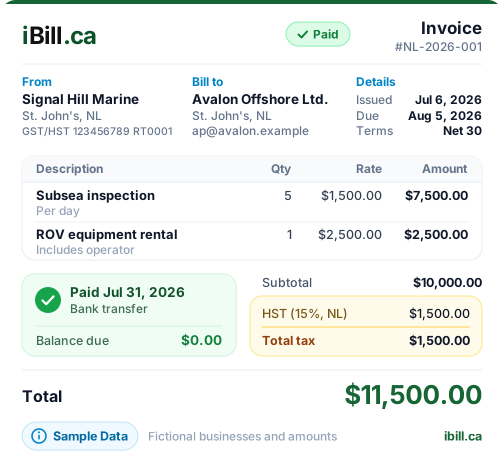
Invoice #NL-2026-001

St. John's Marine Services Ltd.

Subsea Inspection (5 days) $7,500.00
ROV Equipment Rental $2,500.00
Subtotal $10,000.00
HST (15%) $1,500.00
Total Due $11,500.00

NL's offshore sector generates high-value invoices where accurate HST is critical.

Prince Edward Island

15% HST

Tax Structure

Prince Edward Island charges 15% HST, comprising the 5% federal GST and a 10% provincial component. PEI transitioned from a separate GST + PST system to the harmonized model in 2013, eliminating the need for businesses to track two separate tax lines. The move to HST simplified invoicing significantly for Island businesses.

PEI does not currently offer point-of-sale rebates on children's clothing or other items in the way Nova Scotia and New Brunswick do. The full 15% HST applies to most taxable goods and services on the Island, with standard federal exemptions for basic groceries, prescription medications, and medical services.

Key Industries

Prince Edward Island's economy is uniquely shaped by agriculture and tourism, both of which create distinctive invoicing patterns. PEI produces roughly 25% of Canada's potato crop, and the potato industry drives a chain of invoicing from seed suppliers and equipment dealers through to storage facilities, processors, and shipping logistics. Potato farmers invoice processors based on contracted prices per hundredweight, with quality premiums and deductions that vary by variety, size, and sugar content. Equipment dealers and repair shops in communities like O'Leary and Kensington see seasonal surges in parts and service invoicing aligned with planting and harvest.

Tourism accounts for a substantial share of PEI's GDP, with over 1.5 million visitors annually drawn by beaches, Anne of Green Gables, and the culinary scene. The tourism season runs primarily from late June through September, creating a compressed window where accommodation providers, tour operators, restaurants, and event organizers generate the bulk of their annual invoicing. A Cavendish-area tour operator might issue more invoices in July and August than in the remaining ten months combined. Accurate HST documentation during this high-volume period is essential for year-end CRA filing.

PEI's shellfish industry, particularly lobster and oyster farming in Malpeque Bay and the eastern bays, generates export invoicing that requires proper zero-rating documentation. The Island's growing aerospace sector, centred on Slemon Park in Summerside, adds manufacturing and maintenance invoicing to the mix, often involving contracts with national defence and international aviation clients.

Cities and Communities

Charlottetown Summerside Stratford Cornwall Montague Souris Kensington O'Leary Alberton Georgetown

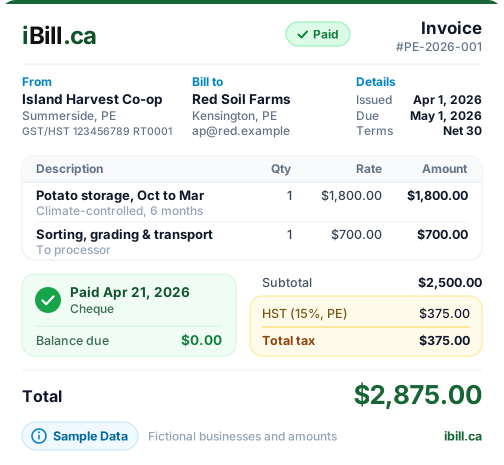
Invoice #PE-2026-001

Island Harvest Co-op

Potato Storage (Oct-Mar) $1,800.00
Sorting & Grading $450.00
Transport to Processor $250.00
Subtotal $2,500.00
HST (15%) $375.00
Total Due $2,875.00

PEI's agricultural economy creates specialized invoicing needs year-round.

Invoice Clients in Any Atlantic Province

iBill auto-detects the correct HST rate based on your client's province. NS at 14%, NB/NL/PEI at 15% - always accurate.

Create Invoice
Trusted by Canadian Businesses — 1,200+ signups

Everything Atlantic Canada Businesses Need

Province-Aware HST

Automatically applies 14% HST for Nova Scotia clients and 15% for NB, NL, and PEI. No manual rate switching needed.

Professional Templates

Choose from multiple invoice templates designed for Canadian businesses across all industries.

Client Management

Store client details by province. iBill remembers each client's location and applies the right HST rate on every invoice.

HST Number Display

Your HST registration number appears on every invoice automatically, meeting CRA compliance requirements.

PDF Export

Download professional PDF invoices to email or print for clients in Halifax, Moncton, St. John's, Charlottetown, and beyond.

Tax Reports for Filing

Generate HST reports broken down by province for easy CRA filing. Track collected tax across all your Atlantic clients.

Serving All of Atlantic Canada

Invoice software for businesses in every Atlantic community

Nova Scotia

Halifax Dartmouth Sydney Truro New Glasgow Bridgewater Yarmouth Lunenburg

New Brunswick

Fredericton Moncton Saint John Dieppe Miramichi Edmundston Bathurst

Newfoundland & Labrador

St. John's Mount Pearl Corner Brook Conception Bay South Paradise Grand Falls-Windsor Labrador City

Prince Edward Island

Charlottetown Summerside Stratford Cornwall Montague Souris

Interprovincial Invoicing Across Atlantic Canada

Atlantic Canada's four provinces form a tightly integrated regional economy. Businesses in Halifax regularly serve clients in Moncton. St. John's contractors take on projects in Labrador City. PEI agricultural suppliers ship to processors across the Maritimes. This interprovincial commerce creates a specific invoicing challenge: which HST rate applies when the supplier is in one Atlantic province and the customer is in another?

Place-of-Supply Rules for Atlantic Businesses

The CRA's place-of-supply rules determine which province's HST rate applies. For tangible goods, the rate is based on the province where the goods are delivered. For services, the rules are more nuanced: the general rule is the province of the customer's business address, but for real property services it is the province where the property is located, and for personal services it is where the service is performed. This means a Saint John plumber working on a cottage in Nova Scotian invoices at 14% HST (Nova Scotia's rate), not New Brunswick's 15%. A Halifax IT consultancy providing remote services to a PEI client invoices at 15% (PEI's rate). Getting this right is important for both the supplier and client, as the wrong rate creates ITC complications. iBill.ca simplifies this by letting you set each client's province and automatically applying the correct HST rate. For more on calculating tax on invoices, see our detailed guide.

The Atlantic Immigration Program and New Entrepreneurs

All four Atlantic provinces participate in the Atlantic Immigration Program, which has been bringing skilled workers and entrepreneurs to the region. Many of these newcomers start businesses and need to understand Canadian invoicing conventions from day one. The $30,000 small supplier threshold for mandatory HST registration is federal and applies uniformly across all four provinces. Below that threshold, registration is voluntary but often advantageous: registered businesses can claim input tax credits to recover HST paid on business purchases. For new entrepreneurs, iBill's invoice generator provides a ready starting point without complexity.

Seasonal Business Patterns Across the Region

Seasonality is a defining characteristic of Atlantic Canada's economy that directly affects invoicing patterns. The fishing season varies by species and geography: lobster season on PEI and Nova Scotia's South Shore runs spring through early summer, while snow crab season in Newfoundland peaks in April and May. Tourism surges from late June through September across all four provinces, with PEI and Cape Breton experiencing the sharpest peaks. Construction is weather-constrained, with most exterior work concentrated between May and November.

For businesses operating in these seasonal industries, invoice volume can vary tenfold between peak and off-peak periods. A Cavendish tour operator, a Cape Breton B&B, or a Lunenburg charter boat captain might generate 80% of their annual invoices in a three-month window. Managing this burst of billing activity efficiently, with correct HST applied and records organized for year-end filing, is where proper invoicing software pays for itself. Our GST/HST return guide covers the filing process for seasonal businesses.

Cross-Border Trade with the United States

Atlantic Canada's proximity to the northeastern United States creates significant cross-border business. New Brunswick shares its entire western border with Maine, and Saint John's port handles international shipping. Nova Scotia's fishing industry exports lobster and seafood globally, with the U.S. as the primary market. PEI exports potatoes and seafood. Newfoundland's offshore petroleum connects to international commodity markets.

Invoices for exported goods and services are generally zero-rated for HST purposes, meaning no HST is charged but the business can still claim ITCs on related expenses. However, the zero-rating must be properly documented on the invoice with supporting export evidence. This distinction between zero-rated exports and standard-rated domestic supplies must be clearly reflected in invoicing records for CRA audit purposes. Maintaining proper CRA-ready documentation with correct zero-rating notation protects your business during reviews.

Atlantic Canada Invoicing FAQs

Do all Atlantic Canada provinces have the same HST rate?
No. As of 2026, Nova Scotia charges 14% HST (5% federal + 9% provincial), while New Brunswick, Newfoundland and Labrador, and Prince Edward Island all charge 15% HST (5% federal + 10% provincial). Nova Scotia reduced its rate from 15% to 14% effective April 1, 2025.
How does interprovincial invoicing work across Atlantic Canada?
Under CRA place-of-supply rules, the HST rate is generally determined by the province where the goods are delivered or the service is performed. If a New Brunswick business provides services to a Nova Scotia client, the invoice should reflect Nova Scotia's 14% HST. iBill.ca lets you set the client's province to automatically apply the correct rate.
What is the HST registration threshold in Atlantic Canada?
The threshold is $30,000 in taxable revenue over four consecutive calendar quarters, and it applies uniformly across all four Atlantic provinces. This is a federal threshold. Below $30,000, registration is voluntary but often beneficial for claiming input tax credits on business expenses.
Why did Nova Scotia lower its HST while other Atlantic provinces stayed at 15%?
Nova Scotia reduced its provincial HST component from 10% to 9% effective April 1, 2025, bringing the total from 15% to 14%. This was a provincial government decision to reduce the tax burden on Nova Scotia consumers and businesses. The other three Atlantic provinces have not made similar changes and remain at 15%.
Are there HST-exempt items specific to certain Atlantic provinces?
Federal HST exemptions (basic groceries, prescriptions, medical services) apply uniformly. However, some Atlantic provinces offer point-of-sale rebates that effectively remove the provincial HST portion on certain items. Nova Scotia and New Brunswick provide rebates on children's clothing, footwear, and diapers. Newfoundland provides a rebate on children's clothing under $100. PEI does not currently offer similar rebates.
Is iBill.ca available for all Atlantic Canada businesses?
Yes! iBill.ca offers unlimited invoicing with automatic HST calculation for all four Atlantic provinces. Works for businesses in Halifax, Moncton, St. John's, Charlottetown, and every Atlantic community.
Can I invoice clients in multiple Atlantic provinces from one account?
Absolutely. iBill.ca handles multi-province invoicing from a single account. Set each client's province and the correct HST rate is applied automatically: 14% for Nova Scotia clients and 15% for New Brunswick, Newfoundland, and PEI clients. Your tax reports will break down collected HST by province.

Ready to create professional invoices for your Atlantic Canada business?

Create Invoice

Start Invoicing Across Atlantic Canada - Get Started Today!

Invoicing software for Nova Scotia, New Brunswick, Newfoundland & Labrador, and Prince Edward Island. Automatic HST on every invoice.

Create Account

- CRA-Ready