
CCA Depreciation Software — CRA-Ready Capital Cost Allowance
Track business assets, calculate depreciation by CRA class, and post to your general ledger automatically. Pool-based declining balance with cost caps enforced.
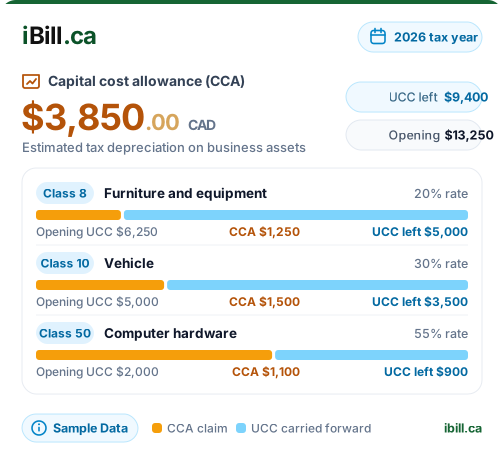
What is Capital Cost Allowance (CCA)?
CCA is the CRA's method of allowing businesses to deduct the cost of depreciable property over time, reducing taxable income each year
Declining Balance Method
Most CCA classes use the declining balance method, where you apply a fixed percentage to the remaining undepreciated capital cost (UCC) of the asset pool each year. This means larger deductions in earlier years and smaller ones over time.
Straight-Line (Class 14)
Class 14 assets such as patents, franchises, and licences with a limited life use straight-line depreciation instead. The cost is spread evenly over the remaining life of the asset rather than using a declining balance rate.
Half-Year Rule
In the year an asset is acquired, you can normally only claim half the CCA you would otherwise be entitled to. This rule applies to most classes and ensures businesses do not claim a full year of depreciation for a partial year of use.
AIIP (2018-2033)
The Accelerated Investment Incentive replaces the half-year rule for property that is new to you. Property bought from 2025 gets the reaccelerated incentive: 1.5x the normal first-year base for most classes (if available for use before 2030), and a 100% first-year write-off for new computers bought before 2027.
Reduce Taxable Income
CCA directly reduces your net business income for tax purposes. Properly tracking and claiming CCA on all eligible assets ensures you are not overpaying income tax — and that your deductions are fully defensible in a CRA audit.
CRA Audit Compliance
The CRA requires businesses to maintain records of all depreciable property, including acquisition date, cost, class, and annual CCA claimed. iBill keeps this data organized and audit-ready in your general ledger at all times.
CRA CCA Classes Supported
iBill supports all major CRA depreciation classes with automatic rate and cost cap enforcement
| Class | Rate | Asset Type | Notes |
|---|---|---|---|
| Class 1 | 4% | Buildings | Commercial and residential buildings acquired after 1987 |
| Class 8 | 20% | Office furniture, equipment, fixtures | Desks, chairs, shelving, photocopiers, and other equipment |
| Class 10 | 30% | Motor vehicles, trailers | Cost cap: $39,000 for 2026 |
| Class 10.1 | 30% | Luxury passenger vehicles | Vehicles exceeding the $39,000 cost cap — each in its own pool |
| Class 12 | 100% | Small tools, software, dishes/cutlery | Tools under $500, computer software, utensils — full write-off |
| Class 14 | Straight-line | Patents, franchises, licences | Depreciated evenly over the remaining life of the asset |
| Class 43 | 30% | Manufacturing and processing equipment | Machinery used directly in manufacturing or processing goods |
| Class 50 | 55% | Computer hardware, systems software | Servers, desktops, laptops, and general-purpose systems software |
| Class 54 | 30% | Zero-emission vehicles | Cost cap: $61,000 — electric and hydrogen fuel cell vehicles |
How iBill Handles CCA
From asset acquisition to annual depreciation and disposal — everything is tracked and posted to your GL automatically
Asset Acquisition Tracking
Record every depreciable asset with its cost, acquisition date, CCA class, and description. Each asset is automatically assigned to the correct pool for depreciation calculations.
Pool-Based Calculation
Assets are grouped by CCA class into pools, and depreciation is calculated on the total pool balance — exactly how the CRA expects it. Pool balances update automatically as assets are added or disposed.
Cost Caps Enforced
Class 10.1 luxury vehicles are automatically capped at $39,000 and Class 54 zero-emission vehicles at $61,000. You never have to remember the limits — iBill applies them before calculating depreciation.
AIIP Factor Applied
iBill applies the first-year factor for each asset from its class, purchase date, and whether it is new to your business: 1.5x for most new property bought from 2025, a 100% write-off for new computers bought before 2027, and the half-year rule (0.5x) for property you or a related person owned or used before.
GL Auto-Posting
When you run annual depreciation, iBill creates journal entries automatically: debit to Depreciation Expense (6900) and credit to Accumulated Depreciation (1610). These flow directly into your financial statements.
Disposal Tracking
When you sell or dispose of an asset, iBill calculates recapture or terminal loss and posts the appropriate journal entries. The pool balance adjusts automatically, and your tax position updates in real time.
Maximize Your CCA Deductions — Automatically
Track every asset, apply the correct CRA rate, and post depreciation to your GL with one click.
Get Started NowCCA Calculation Example
See how declining balance depreciation works for a Class 8 asset over three years
Class 8 Asset — 20% Rate
Office equipment bought for $50,000 from a related company that already used it
If the equipment were new to you (AIIP, bought in 2026): Year 1 would be $50,000 × 20% × 1.5 = $15,000, three times the half-year amount.
CCA Classes, AIIP Rules, and Disposition
Detailed guidance on commonly used CCA classes, the Accelerated Investment Incentive, and what happens when you sell or dispose of an asset.
Additional CCA Class Examples
Beyond the major classes shown in the table above, here are additional CCA classes that Canadian small businesses frequently encounter:
Class 8 -- 20% (Furniture & Equipment)
Office furniture (desks, chairs, shelving), photocopiers, fax machines, telephones, and miscellaneous tangible capital property not covered by another class. This is the catch-all class for most business equipment that does not fit elsewhere.
Class 12 -- 100% (Small Tools & Software)
Tools costing less than $500 each, kitchen utensils, medical/dental instruments under $500, computer software (not systems software), and uniforms. Full write-off in the year of acquisition, subject to the half-year rule or AIIP adjustment.
Class 50 -- 55% (Computers)
General-purpose electronic data-processing equipment (computers, laptops, tablets) and systems software acquired after March 18, 2007. Servers, monitors, printers, and associated peripherals also fall in this class.
Class 14 -- Straight-Line
Patents, franchises, concessions, and licences with a limited life. Unlike most classes, Class 14 uses straight-line depreciation over the life of the property, not declining balance. For example, a 10-year patent is depreciated at 10% per year.
Class 14.1 -- 5%
Goodwill, trademarks, customer lists, and other eligible capital property with no limited life. Replaced the old Eligible Capital Property (ECP) rules. The 5% rate is on a declining-balance basis.
Class 43 -- 30% (Manufacturing)
Manufacturing and processing machinery and equipment. This class is for tangible assets used primarily (more than 50%) in the manufacturing or processing of goods for sale or lease. Note: This is not for clean energy equipment -- that falls under Class 43.1 (30%) or 43.2 (50%).
Year-Over-Year Depreciation Walkthrough
Let us walk through a complete multi-year CCA calculation for a common scenario: buying a $2,400 laptop (Class 50, 55% declining balance) in 2026 from a related person who already used it, so the standard half-year rule applies (not AIIP):
| Year | Opening UCC | CCA Rate | CCA Claimed | Closing UCC |
|---|---|---|---|---|
| 2026 (Year 1) | $2,400.00 | 55% x 0.5 | $660.00 | $1,740.00 |
| 2027 (Year 2) | $1,740.00 | 55% | $957.00 | $783.00 |
| 2028 (Year 3) | $783.00 | 55% | $430.65 | $352.35 |
| 2029 (Year 4) | $352.35 | 55% | $193.79 | $158.56 |
| 2030 (Year 5) | $158.56 | 55% | $87.21 | $71.35 |
After 5 years, you have claimed $2,328.65 of the $2,400 cost. The remaining $71.35 UCC continues to decline each year. With a declining-balance method, the pool is never fully depreciated to zero.
AIIP: Accelerated Investment Incentive Property (2018-2033)
The Accelerated Investment Incentive Property (AIIP) rules, introduced in the 2018 Fall Economic Statement, replace the half-year rule for eligible property acquired after November 20, 2018. Property acquired after 2024 falls under the reaccelerated incentive, which runs for property that becomes available for use before 2034. Under these rules:
- The factor is 1.5x for most classes: for property bought from 2025 and available for use before 2030 (1.0x if available for use 2030-2033), and for property bought from November 21, 2018 to 2024 and available before 2024 (1.0x in 2024).
- Computers (Class 50) bought new before 2027 are written off in full in the first year. For our $2,400 laptop bought new in 2026, Year 1 CCA is the full $2,400, compared to $660 under the half-year rule in the example above.
- AIIP applies to all CCA classes except Class 14.1 (which has its own transitional rules) and certain specified energy property.
- The property must be new to you -- it cannot have been owned or used before by you or a person not dealing at arm's length with you, such as a related person. Property bought second-hand from an unrelated seller can qualify.
- After the incentive: property that becomes available for use after 2033, and property you or a related person owned or used before, get the standard half-year rule (0.5x).
The Half-Year Rule Explained
The half-year rule (also called the "50% rule" or "available for use" rule) limits the CCA you can claim in the year you acquire a depreciable property. Regardless of when during the year you purchase the asset, the CCA deduction in the first year is calculated as if you only owned it for half the year. The rationale is that, on average, assets are acquired midway through the year. This means:
- Year 1 CCA = Cost x CCA Rate x 0.5 (half-year rule)
- Year 2+ CCA = Opening UCC x CCA Rate (full rate applies)
- The half-year rule applies to the net additions to the class during the year (acquisitions minus dispositions)
- If you dispose of more property than you acquire in a class during the year, the half-year rule does not apply to that class
Disposition Rules and CCA Recapture
When you sell, trade, or otherwise dispose of a depreciable asset, the proceeds affect your CCA pool. The tax consequences depend on the relationship between the sale proceeds and the undepreciated capital cost (UCC) of the class:
- Proceeds less than UCC (terminal loss) -- If the disposed asset is the last property in its class and the proceeds are less than the UCC, the remaining UCC is fully deductible as a terminal loss. For example, if the UCC is $500 and you sell the last asset for $200, you deduct the $300 difference as a terminal loss.
- Proceeds greater than UCC but less than original cost (CCA recapture) -- If proceeds reduce the UCC below zero, the negative balance is included in your income as "recapture" of CCA. This means you are paying back some of the depreciation you previously claimed. Recapture is taxed as regular business income on your T2125.
- Proceeds greater than original cost (capital gain) -- For CCA purposes, the amount deducted from the class is capped at the original cost, not the sale price. Any excess over the original cost is a capital gain, of which 50% is included in income (the capital gains inclusion rate for gains up to the $250,000 threshold).
- Trade-ins -- When you trade in an old asset for a new one, the CRA treats this as a disposition of the old asset at its trade-in value and an acquisition of the new asset at its full cost. Both events affect the CCA pool.
Important note on Class 10.1 (passenger vehicles over $39,000): Each vehicle over the cost threshold is placed in its own separate Class 10.1. There is no terminal loss or recapture on disposition of a Class 10.1 vehicle -- the remaining UCC simply disappears. This is a deliberate CRA rule to prevent tax benefits on luxury vehicles.
CCA Depreciation FAQs
Ready to track your assets and claim every CCA deduction?
Create AccountTrack Every Asset, Claim Every Deduction
Trusted by Canadian businesses using iBill's CCA depreciation tools.
Create AccountUnlimited Invoices • CRA-Ready