
Understanding the difference between invoices and receipts is essential for running a professional Canadian business. While they may seem similar, these two documents serve very different purposes in your financial workflow. Getting them right is crucial for CRA compliance, proper bookkeeping, and maintaining professional relationships with your clients.
The Key Difference: Before vs After Payment
The fundamental difference between an invoice and a receipt comes down to timing:
Invoice
Sent BEFORE payment
- A request for payment
- Lists what you provided
- States the amount owed
- Includes payment terms
Receipt
Issued AFTER payment
- Proof of payment
- Confirms payment received
- Shows payment method used
- Closes the transaction
Simple Way to Remember
An invoice says "Please pay me." A receipt says "Thank you for paying."
Detailed Comparison: Invoice vs Receipt
| Feature | Invoice | Receipt |
|---|---|---|
| Purpose | Request payment for goods/services | Confirm payment was received |
| When Issued | Before payment (after work/delivery) | After payment is received |
| Payment Status | Payment pending/outstanding | Payment complete |
| Legal Function | Creates accounts receivable | Proves payment was made |
| Required Info | Detailed line items, taxes, terms | Amount paid, date, payment method |
| Who Uses It | Service providers, B2B transactions | Retail, point-of-sale transactions |
Create Professional Invoices in Minutes
iBill creates CRA-ready invoices with automatic tax calculations, payment tracking, and professional PDF export.
Create InvoiceWhen to Use an Invoice
Invoices are typically used in business-to-business (B2B) transactions and service-based work where payment comes after the work is done. Use an invoice when:
- You complete work before receiving payment - Consulting, freelance work, professional services
- You deliver products on credit - Wholesale orders, ongoing supply relationships
- You have payment terms - Net 30, Net 15, or other delayed payment arrangements
- You need to track accounts receivable - Managing what clients owe you
- The client needs documentation for their records - Business expense tracking
What to Include on a Canadian Invoice
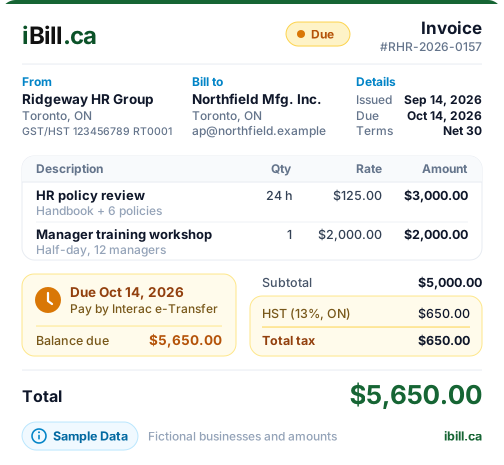
- Your business name and contact information
- Client's name and billing address
- Unique invoice number
- Invoice date and due date
- Detailed description of goods/services
- Quantity and unit prices
- Subtotal before taxes
- GST/HST/PST amounts with registration number
- Total amount due
- Payment terms and accepted methods
When to Use a Receipt
Receipts are used primarily in retail and point-of-sale transactions where payment is made immediately. Use a receipt when:
- Payment is made at time of purchase - Retail stores, restaurants, service counters
- The customer pays immediately - Cash, debit, or credit card at checkout
- No invoice was issued - Spontaneous purchases without prior agreement
- A client requests proof of payment - After settling an invoice
- You need to document cash transactions - For your own records
What to Include on a Receipt
- Your business name and address
- Transaction date
- Receipt or transaction number
- Description of items purchased
- Total amount paid
- Tax amounts (GST/HST/PST)
- Payment method used
- "PAID" or "Payment Received" notation
CRA Requirements for Invoices and Receipts
The Canada Revenue Agency has specific requirements for both invoices and receipts, especially if you're registered for GST/HST.
For GST/HST Registered Businesses
If you charge more than $30,000 annually, you must register for GST/HST. Your invoices must include:
- Your GST/HST registration number (format: 123456789RT0001)
- Total tax charged or statement that tax is included
- For invoices of $100 or more: the tax charged, or a statement that tax is included and the total tax rate
- For invoices of $500 or more: buyer's name, payment terms, and a description of each item
Important: Keep Records for 6 Years
The CRA requires you to keep copies of all invoices and receipts (both issued and received) for at least 6 years. This applies even after you close your business.
Input Tax Credits
To claim input tax credits (ITCs) on your GST/HST return, you need proper documentation. Invoices from your suppliers must include all required information for you to claim the GST/HST you paid.
Examples: Invoice vs Receipt
Invoice Example
Receipt Example
RECEIPT
ABC Office Supplies
123 Main Street, Toronto, ON
Date: January 20, 2026
Transaction #: R-89421
Printer Paper (5 reams): $45.00
Ink Cartridge: $89.99
Subtotal: $134.99
HST (13%): $17.55
Total Paid: $152.54
Payment Method: Visa **** 4521
PAID - Thank you!
When You Need Both: The Complete Workflow
In many business transactions, you'll use both an invoice and a receipt. Here's the typical workflow:
- Complete the work or deliver goods
- Send an invoice requesting payment with due date
- Client reviews the invoice and processes payment
- Receive payment via e-Transfer, cheque, or other method
- Issue a receipt or mark the invoice as "PAID"
Pro Tip: Mark Invoices as Paid
Many businesses simplify this by marking the original invoice as "PAID" with the payment date and method. This serves as both the invoice and receipt, which is perfectly acceptable for CRA purposes. iBill.ca automatically tracks payment status and can mark invoices as paid when you record payments.
Common Mistakes to Avoid
1. Using Receipts Instead of Invoices for B2B
Business clients need proper invoices for their expense tracking and tax deductions. A simple receipt may not include all the information they need. Always provide a detailed invoice for business transactions.
2. Not Including GST/HST Registration Number
If you're GST/HST registered, your registration number must appear on all invoices. Clients cannot claim input tax credits without it, which can damage business relationships.
3. Forgetting to Issue Receipts for Cash Payments
Always provide receipts for cash transactions. This protects both you and the customer, and creates proper records for CRA compliance.
4. Using the Same Number Sequence
Invoices and receipts should have separate numbering systems. This helps with organization and prevents confusion during audits.
5. Not Keeping Copies
Always keep copies of every invoice and receipt you issue. Digital storage is acceptable and often easier to organize than paper files.
Manage Invoices and Receipts Effortlessly
iBill.ca automatically creates professional invoices, tracks payment status, and keeps all your records organized for CRA compliance.
Get Started TodayFrequently Asked Questions
What is the main difference between an invoice and a receipt?
An invoice is a request for payment sent BEFORE payment is received, listing goods or services provided and the amount owed. A receipt is proof of payment issued AFTER payment has been made, confirming the transaction is complete.
Do I need to provide both an invoice and a receipt in Canada?
In most business-to-business transactions, yes. You send an invoice to request payment, then provide a receipt (or mark the invoice as paid) once payment is received. For retail transactions, a receipt alone is typically sufficient since payment happens immediately.
What does the CRA require on invoices vs receipts?
For GST/HST purposes, invoices must include your business name, GST/HST number, invoice date, description of goods/services, and tax amounts. Receipts should show the date, amount paid, payment method, and confirm the transaction. Both documents should be kept for at least 6 years.
Can an invoice also serve as a receipt?
Yes, many businesses mark invoices as "PAID" once payment is received, which effectively serves as both the invoice and receipt. This is a common and accepted practice, especially when using invoicing software like iBill.ca that automatically tracks payment status.
Ready to create professional invoices and track payments?
Create Invoice