
Billing Best Practices for Canadian Accounting Firms
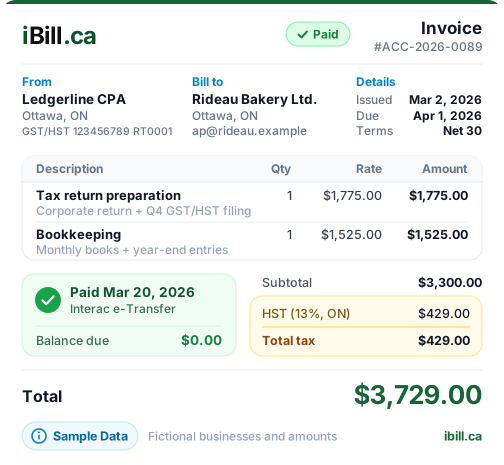
Canadian accountants and CPAs operate in a profession where billing is inherently seasonal, service categories are diverse, and client expectations around transparency are high. Unlike many service businesses that bill a single rate for a single deliverable, an accounting firm might invoice a client for T2 corporate tax preparation, monthly bookkeeping, GST/HST return filing, payroll processing, and advisory services -- all on the same statement. Each service may carry a different hourly rate depending on whether it was performed by a partner, a senior accountant, or a junior staff member. Managing this complexity requires a disciplined approach to invoicing that many firms overlook until cash flow problems force them to act. If you work closely with a bookkeeper who handles day-to-day transaction entry, coordinating your invoices to avoid billing overlap is essential.
Seasonal Tax Preparation and Surge Billing
Tax season in Canada runs from February through June for most firms, with a secondary surge around the September 30 deadline for trusts and deceased individuals. During these peak periods, some firms bill premium rates for rush filings or apply surcharges for late-arriving documentation. Your invoices should clearly distinguish between standard preparation fees and any rush or complexity surcharges. Itemizing by return type -- T1 personal, T2 corporate, T3 trust, T5013 partnership -- helps clients understand exactly what they are paying for and provides a clear audit trail for your own CRA tax reporting.
Monthly Retainers and Advisory Services
Many accounting firms structure their ongoing client relationships as monthly retainers that cover a defined scope of bookkeeping and compliance work. The retainer invoice might include a flat fee for up to a certain number of transactions per month, with overage billing for additional volume. Advisory services -- such as business valuation, succession planning, or CRA audit representation -- are typically billed separately at higher rates. Creating separate line items for retainer work and advisory engagements on the same invoice gives clients a clear picture of where their money goes, similar to how a management consultant would break down strategy and implementation fees.
Trust Account Management and Compliance Filing Fees
Accountants who manage trust accounts or handle compliance filings on behalf of clients carry additional billing responsibilities. Trust administration fees, estate accounting charges, and government filing fees (such as annual return fees or T3 slip preparation) should be invoiced with precise descriptions and dates. The CRA expects clear documentation of all fees charged in connection with trust and estate work, making detailed financial statements and well-structured invoices non-negotiable. Maintaining organized records from the start saves significant time during reviews or audits and protects both you and your clients.
Value Pricing vs Hourly: When Canadian Accounting Firms Switch Models
The Canadian accounting profession has been gradually shifting from traditional hourly billing toward value pricing and fixed-fee engagements for predictable work. The argument is straightforward: when your invoicing speed improves with better software, clients should benefit from the efficiency gains rather than seeing fewer hours billed for the same outcome. Provincial CPA orders have published commentary supporting transparent fixed-fee arrangements provided the engagement letter clearly defines scope and overage triggers. For routine tax preparation, monthly bookkeeping, and standard compilation engagements, fixed fees work well because the scope is bounded. For audits, complex tax planning, and litigation support, hourly billing or a fixed-fee-with-WIP-tracking hybrid remains the practical model because scope discovery is itself part of the work.
Many firms now run a mixed book: fixed-fee for compliance services that drive predictable cash flow, hourly for advisory engagements where the value depends on time spent thinking through the client's situation. The transition typically requires reworking how scope is documented at the engagement-letter stage and adding explicit overage triggers to protect against scope creep — but firms that have made the switch report higher client satisfaction and steadier monthly cash flow. The single biggest implementation risk is shipping fixed-fee engagements without overage protection; without a contractual overage trigger, a single high-complexity client can absorb a partner's entire week at compliance-grade margins.